Showing posts with label sacred things. Show all posts

2.06.2014

"The God of the Bitter-Black Wood", or, "Seven Glass Eyes"


Once there was a wicked man, who lived far too long, and on his belt was a leather sack, and in the sack were seven glass eyes. And each day he would open his sack, and the eyes would turn and look at him, until one day, they would not look away, and he could no longer live in the city of men. So he left, and went into the empty lands.

And on his belt he had another leather sack, and in this sack were seven berries, bitter-black and dry, with the seeds rattling in the heart of them. But the empty lands were so empty! So he took from the sack the seven berries, bitter-black and dry, and buried them in little mounds, and waited for the rain. The rain took a long time in coming, but he waited, for he had already lived far too long, and he had time. And then the rain came, and the little berries sprouted thickets, bitter-black and thick with thorns.

Then the man went round to the seven bitter-black hedges, and opened up his other sack, and in the nook just above the roots, he nestled, in each hedge a single glass eye. And then he trimmed the low branches, so that the hedge grew high and broad into seven trees, and the gnarled thorns wrapped round themselves into a trunk, and in the wrapping, wrapped around the eyes, and closed them in tight. And the growing took a long time in coming, but he waited, for he had already lived far too long, and he had time.

And then he waited, for the trees to bear their fruits, for the winter was coming on, and the flowers were fallen, and the buds displaced. And the fruit too was slow in coming, but it came, too, rich black-violet, and heady with its own smooth bitterness. And the birds came down and gnawed their beaks against the bitter-black skins, until each thousand-fruit split broad, and in the center of each fruit was a pink and mournful tongue. And all the tongues cried out against the man.

And though the growing had been slow, the song was quick, and the hearing quicker, and a great storm came down, and it tore and fought, and heaved and wept, and buckled and drank, and vomited all that it drank down. And when the storm was gone, the man came out from under a brake of ferns, and six trees lay before him, snapped off at the trunks, just above the ground. And in the jagged stumps, laid clean and clear and watchful, there were six glass eyes. And the man rejoiced and took the eyes, and put them in his leather sack. And the tree that still remained stood quiet in the empty-lands, and said nothing.

But God came down then, and sat by the man and watched him as he tied the sack up tight. And he watched as the man went to the lone remaining tree, and from it plucked seven berries, closed up and shriveled, dry and rattling, and he put them in the other sack. And then, the wicked man, turned and he looked at God, and God was what he always had been - not God, but just the God of the Bitter-Black Wood. And the wicked man reached out his hand, and the God of the Bitter-Black Wood plucked out his glass eye, and set it in the open palm of the wicked man. And the wicked man put the eye in the little leather sack, and turned to walk back toward the city of men.

Read More......

12.03.2012

The Voice Behind the Voice

I suppose it might be a vice, but I think its intoxicating to listen to recordings of poets and writers I already love. This is odd, because I don't like it in reverse - for instance, reading song lyrics that I heard first makes them feel somehow less - maybe I've just never had the right experience, but removing a spoken word to the page feels like translation and reduction. Taking a poem on the other hand, and having the poet read it, feels like a different, entirely separate work of art, particularly if I already know the written work well enough.

I was reminded of this, this week, when I listened to Madeleine L'Engle read an audiobook of "A Wrinkle in Time" (by the way, whichever of my friends knew this existed, and failed to notify me, I'm very disappointed in you (j/k)). When I first read this book as a kid, I believed Ms L'Engle was British, actually - I imagine it was simply that where I lived, people did not have lovely, romantic names that must be spelled with apostrophes, and that are difficult to alphabetize properly. And though I did learn better, this manufactured voice is what I heard the book read in, pretty much my whole life. Listening to Ms L'Engle changed this entirely, for me, made m understand the book in a slightly lisping, cranny-filled Northeast accent in a way that made the book even more beautiful than it had been.

It also reminded me of two New Yorkers I've heard the voice of: Jack Kerouac and Walt Whitman. Walt Whitman, who was recorded so early we're lucky to have him at all, positively shocked me the first time I heard it - his poetry is all fire and boldness, and I pictured it being read like a sermon, the way that Dylan Thomas (hilariously, to me) reads his poetry (no, seriously, listen to him read, its like the 'Death Comes Unexpectedly' scene from Pollyanna, and was WITHOUT A DOUBT imitated (poorly) by me in the golden days of Death and Baby Death if you've wondered). Mr. Whitman, though, first of all has an accent that we tend to resere now for movie characters (the closest analog in terms of dialect in my mind is the masterfully researched performance of Daniel Day Lewis as Bill the Butcher in Gangs of New York (warning for content on that one - I'm just saying it was well researched, I've never been able to stomach the film well enough to tell if I like it). Only, instead of the accent being in a continuous snarl, You hear this strain of almost fragile love through everything - all that poetry about the wide, expansive united states, poetry we often asscoiate with empty fields and rural imagery (also his voice, and a strange, strange commercial on top of it all) suddenly compressed into a little garret anda drinking hall in Greenwich.

In other poets one hears something else - Plath and Woolf and Sexton are all recorded reading their work, and each one, in my mind has this edge of something almost like hatred in thier tone, almost like they are daring you to listen, the cycnic trying to hope. Sylvia Plath recordings keep me awake at night.  Or in a James Joyce recording, one hears how fully he inhabits what he's writing, how much his writing really was simply a voice in his many-voiced head. Or with Yeats, you hear his fragility, his tottering air of almost continuous shock at the world he's in.

Anyway, it's December, and I thought about these all this morning, and I thought I would collect links to listen, in case you've never heard them. If you know any other revealingly recorded poets and writers, I'd love to hear about them.

Madeleine L'Engle reads from "A Wrinkle in Time"

Sylvia Plath reads "Lady Lazarus" or "Daddy"

Virginia Woolf reads an essay entitled "Craftsmanship"

Anne Sexton reads "The Truth the Dead Know"

Dylan Thomas reads "And Death Shall Have No Dominion"

Jack Kerouac reads "Charlie Parker"

WB Yeats reads "The Lake of Inisfree"

James Joyce reads from "Finnegan's Wake"

Walt Whitman reads "America"

Read More......

4.08.2012

Other-Help

So many of my favorite people in the book blogging world - Ms Amy, Ms Nymeth, and Ms Debi, for example, and others as well, some more qquietly, some more subtly - have made comments lately that pointed at a feeling as if they are not contributing enough to the world, that they wonder if what they do 'matters', somehow. And then, somewhere else today I saw something that talked about the 'self-help' industry, and I thought about that feeling. Its one I'm pretty familiar with myself.

So, here's the question. The point of self-help is to help us accomplish our goals, right? Self-help is all about helping us lose weight, helping us get ourselves closer to our idea of the divine, helping us make ourselves happier, helping us understand ourselves, to learn to do great things. I don't say this to denigrate these ideas. I am in favor of great things. Great things are great.

But, the people I've loved most in my life have often never done great things, because often enough they were not helping themselves. They were helping others. And helping others is a very difficult thing. While there are plenty of places to do it, there are few that tell you how. And its tremendously dangerous - I've hurt more than one person I've tried to help in my life. And, in its best form, at the end, you yourself have accomplished nothing. But the people who have this skill, to me, are my favorites.

Statistics, achievement, fame, and 'success' do not, ever, effectively measure how much we help other people's greatness, they can only hint at our own achievements. To all my favorite people, I want you to know, that you are greater than you think, greater than anyone can possibly explain to you, greater than you will ever be awarded for, greater than any of the rest of us deserve.  The greatest of the great are measured by the greatness that others around them achieve. So many of my favorite people speak often about how much they love and admire their own friends, how they are often amazed by how much their friends achieve, by the amazing things they do, by the marvels they create. If you know people that you love and admire, and they seem to be better, more beautiful, more loveable, every year, perhaps, friends, you are a bit to blame for that.

Read More......

7.21.2011

The Progress of Other Gods' Pilgrims

My children have for a few years now been slowly working through a best of list of literature for children, broken down by age group. My eldest is in a group of books now that has what I found to be a curious choice: John Bunyan's Pilgrim's Progress. Not to say the book is inappropriate for children. Its not, it is, in fact, probably throughout history one of the books children read, depending on the time period and nation. Historical New England comes to mind. Its just that... well, its an allegory. We don't really read allegory anymore - or when we do, its been swallowed almost entirely by the self-help genre. 


Which is, after all, not so strange a thing. Pilgrim's Progress is, more or less, a self-help book, the old Protestant equivalent of, say, The Alchemist, a book that is meant to tell a story mostly only in order to keep you from being bored long enough that it can tell you what to think. I say that, and it sounds like I hate Pilgrim's Progress - I don't. I thought it was more ridiculous when I was younger. I don't know. 

The difference, I suppose, is very simple - Bunyan is so terribly, terribly earnest. I don't agree with him, no, but I think when a soul is that earnestly seeking something, its able to tell you something very interesting about the thing sought. The seeker, in some ways, knows the object of his search must better than the possessor, and honestly, I don't think Bunyan thought of himself as a possessor, yet (though he was a Calvinist, so predestination would come into play, I suppose, but I could write a whole other post on how fatalistic philosophies and individual freedom are strange but copiously affectionate bedfellows sometimes). 

I am the opposite of Bunyan in so many ways. There's the obvious ways, of course: Bunyan is a devoted Protestant, I'm not entirely sure there is a god, or if there is, if he's a loving one that I want to identify with. Bunyan was a social conservative, I tend to connect morals with the individual and their inner life, rather than society and the outer life. Bunyan, for all his idiosyncrasies, was a literary genius (and no, I'm not the only one who thinks so). And, he wore a mustache. 

But more than this, there is a fundamental difference: Bunyan was a preacher. I don't lean on the religious aspect of this, I think Lenin was a preacher in much the same way, or Malcolm X, as much as Martin Luther King. He is a declaimer. I'm not. I cannot imagine being sure of anything emotional/spiritual/political/social, so much that I could teach it. Discussing it is difficult enough, sometimes, and I'm frequently disgusted with myself enough after that enterprise. And, Christian, the Pilgrim that is Progressing in the book, is a preacher, too. So, following him is a maddening flip-flop, for my morally soft brain. 

I learned the trick of reading it, though - to stop wondering if I agree. This is a double-edged trick, and hard to wield sometimes - you're obliged to ignore both those moments when you agree and when you disagree. But for me, at least, taking approval and disapproval out of the question (as much as possible), leaves bare something purer than dogma and direction - it leaves the simple story of a man pursuing an idea to exclusion.  It hardly matters why he believes what he does, or even what he believes. The thing is simpler than that - it is a little testimony that says "Yes, a soul can follow its ideals, completely. A soul can be faithful to truth itself." With that testimony, there is, for me from hundreds of years later, a little question though: "Is that virtue?" 

Again, I mean to separate this question from the particularities of Christian. It DOES NOT MATTER what ideal he is following. In fact, just the other night my wife and I were talking about Lord Byron, and how, contrary to the idea we front of a man who was dissipate and  amoral, Lord Byron had an ideal, and whether or not you agree with it or not,  he followed it, in earnest, with greater faith and steadiness, in many ways, than some of the best of Christians followed theirs. Call the book "The Radical Romantics Progress." Enjorlas, in Victor Hugo's 'Les Miserables' is another great example - a man capable of being precisely one thing, all the time. And, if you want to read a stirring, inspiring, horrifying statement of the muddled observation I'm making here, read Enjorlas and his journey from the back room of a cafe to the top of a barricade to a pool of his own blood - and then think of other men's blood he pooled into his own to get there. And realize that he meant it, every word. 

And there's the problem with being in earnest (and perhaps the fault in Pilgrim's Progress) - can you live life entirely honestly, earnestly, directly, surely, and not hurt anyone else in the process? Christian, in the progress leaves his wife and children - and the scene in which he weeps over their not listening to him and following him on the path to heaven is, for me, one of the most heartbreaking in the book. The best of earnest men, I think, are destined to fall, because at some point, they realize that their desire for purity and direction will involve someone else. Truth is a harsh lover, and at some point, always makes you choose between her and the other ones you love.

People make such an effort, of course - that's the root of monasticism, I think, in many ways. What is a monastery but a group of people who have promised each other to be glad to all suffer for the same end? Or a hermit. When I hear about the desert fathers of early Christianity, wandering into the sands of Egypt to take up abode in some broken hulk of of stone, and there to live alone, calling God, that fear of impurity is I think, as much a fear of burning up the impurity, as having it extinguish the fire. 

That's the thing about heroic journeys, though - they always end up alone. We tend to focus on the heroes, and so we feel the great stoic pain of solitude in that - Odysseus struggling against the sea alone, Harry Potter walking through the woods alone. And think of that, in Harry Potter, how hard she had to work to convince us, the audience, that yes, yes, Harry is virtuous to walk alone into the wood. Why must she spend so long in the book showing us that its the only alternative? Why must it be utterly clear that it is a choice between killing his friends or killing himself? Because we want it to be NOBLE that he's going to leave aching, bleeding holes in the supporting cast we've come to love: Ginny, Ron, Hermione, everyone. They are the ones who will suffer if he dies. It takes courage to die, but it is, at least a choice. Suffering you did not choose is, somehow, worse, at least to me. And the dying has an end. The aching doesn't. 

At one point I thought, int his vein, how wonderful it would be to be a Buddhist. The perfect Buddhist is the one who relinquishes everything - the Buddha himself stayed on earth rather than immediately ascending to Nirvana because he felt he had to fulfill duty first, to teach what he had learned. So in some sense, his whole life is no more than a long noble search for the freedom to cease being. But, at some level, I have to ask - is that, really, noble? Buddhism itself, to my understanding has grappled with this idea. The tradition of the Boddhisatva in some strains, is that these are souls who have achieved Buddhahood, but had such compassion for the world, that they choose to be the last living souls to enter Nirvana, to continue returning and returning and returning to the world to hope the rest of us on. There is an angels-on-the-head-of-a-pin question there, though, that has an interesting ramification: if ten Boddhisatvas have all promised to be the last to enter Nirvana, which of them enters first when they are all that is left? In a sense, perhaps the implication here is that there will never be the opportunity for the question to be answered - that is, the answer hardly matters, because the question will never be asked. The world is composed of suffering, so there will always be more men suffering, awaiting help to free themselves from it. 

This is the sadness and beauty of the Quixotic hero - the Pilgrim travels because there is a destination, the Boddhisatva travels because there is a road, and if the road is a circle, there is always another place to step forward into. Hopeless infinity is the only hope so grand that it can consume a noble life beyond the limits of human imagination. The only quests, in some sense, worth pursuing, are those in which you're sure to fail. 

Read More......

5.30.2011

Hymn

O, pipe the hymn both clear and loud:
  "Come soon, thou golden dream!"
The altar sends the incense up --
  Though flesh-smoke feed the stream -
"Come quick, thou light, both clean and bright!"
  Though born a crimson gleam.
O pipe it loud! Drown out the sounds
  Of the sacrifice's scream.
 
Bleed out thy scream, O sacrifice,
  Thou destined cinder-grey!
The crisp of thee in sinuous stream,
  The gleam 'neath an empty vein,
The elegy of a Silver Dream,
  Keened out in Bean-sidhe lay:
Bleed out, and silence thou become -
  Now comes the break of day!

Read More......

1.31.2011

A Sense of Place in Lagerlof and Cather

Alright, slight raving side note: The Story of Gosta Berling, by Selma Lagerlof is one of the most beautiful novels I've read in a very long time. I could do a month of posts on this book. I may do one or two more, and make you all so sick of this book I'll ruin your opportunity to discover the beauty of Selma Lagerlof's beautiful vision. So, I'm trying to restrain myself here.

One of the things I loved about this novel (and there are several others) was the powerful feeling of place - I commented to a few people while reading it that it reminded me of Willa Cather's sweeping powerful Nebraska and New Mexico, and the farther I got into the book, the more I felt this - both Cather and Lagerlof leave me with a deep nostalgia for a place I've never been. Thomas Hardy has this feeling for me in his books somewhat, as well, but I don't feel his love for the place he's talking about as much as his horror at the absence of the place. Victor Hugo makes me feel this way about Paris - but in Paris, he is in love with the city, and a city is in many ways just an expression of human beings (another book that feels this way to me is Moby Dick, but with a ship instead of a city). Lagerlof and Cather make you feel in love with something much bigger than you, with the earth itself, I suppose. In Cather, they are these wild places that humans are trying to find an uncomfortable toehold in - in Lagerlof it is a country that has been settled for thousands of years, but where nature and the man-less world lives just outside the edges of day-to-day life. And in both, you see the country exhibit itself in the souls of the people who live there - but not as a sort of clumsy allegory, but rather in the way that we really that people really DO entwine themselves with their native land.

This is particularly powerful to me, because I don't HAVE a 'native soil.' I love my upbringing in this sense, I love that I could see so many places as a child, I think it was good for me. But, at the same time, I would love to truly know and love a place, to be married to the soil in the consummated way that some people are (less so in America, these days, which I think is interesting). That feeling of deep intimacy with a place makes one feel, in some ways, like a perpetual outsider.

It's strange, because the closest I can come to this feeling of deep and powerful intimacy with a place is with the internet itself (ah, yes, insert laughs here, it's okay). I've lived in the soil of the internet now for almost two decades, at some level, and for most of the time, the internet has been a deep and intimate part of my life. Like Cather knew the sweep of the blank prairie, and the way the earth grows beneath it, the way it bites back angrily at the plow, I know the ether of the web, I know the way an empty palette gnaws at a new piece of code, the way that a refugee can stare at it and hunger for their native land, but also dream deep and strong of what they can make of their new home. The way that Lagerlof knows the wolves, the winter wind, the water that comes in the spring floods, I know the angry rises and falls of this pseudo-landscape, the way worlds will form and dissolve with the impartial fury of a decimating blizzard. I know the way that this land can take a person and gnaw them until it leaps one day to devour them whole, and the way that it can cradle up someone lost and yield a little hole for them to make into a home. I've seen it in people I love, in stories that already feel so strange and elemental to be like folklore, I've seen it in myself - like a land, the internet proves it's veracity by being a place where one can be all the selves one is, at the same time.

The strangeness of this realization was that it feels, to me, more like Cather than Hugo - the internet feels like a land, not like a city. IT's inhabitants feel like they are connected to the earth, not cooped into metropolitan finality. It's the sort of place where I can imagine stories living of their own power, instead of simply as currents in a river of human existence (This is not to say that a city isn't just as beautiful, in it's own way). Sadly, I can't WRITE like Lagerlof or like Cather, but I've wondered how long it is until the Cather of the internet is born, telling the story not of the heroes of the land, but of the land itself, the writer who will see this ether plucked from ourselves almost unwilling as a character instead of a setting.

The power of Lagerlof is that she loves her land so much that she loves it's sins and horrors. Her Gods and Heroes are of the ancient cast, the kind that are equal measures of good and evil - how do you tell that story in a world where opinion is, in some sense, the root of identity?

Read More......

7.08.2010

The Sound of Drowning


I read a fascinating article, today, on drowning. I highly recommend it both for the fascination of it, and for the fact that, if you are ever near the water, it is decidedly useful information to know (which, in a story about bad things that can happen to your kids, is a rarity, being far more often drowned out by 'you should be frightened' and 'we are heroic for telling you so'. Sorry, don't mean to snark my bias).

But what was interesting to me was the concept (which I had learned before, but never so vividly) - that drowning, a kind of death that (at least for many people) is inescapably connected with panic, is, more or less, silent. The silence is, in fact, one of the best signs that something is wrong. Which of course, made me consider, the deeper implications of that, the metaphorical parallels. People who are going to commit suicide withdraw sometimes, people who are being abused can become uncommunicative, people who have been traumatised can do the same (this is not a professional statement, I know that people react in very different ways, and may do just the opposite, so forgive me the generalization). But silence, generally, is a sign that something is wrong.

That's interesting to me, because what we, as humans, do (or at least *I* as a human do) is to begin to be afraid of that silence. In a joking way you hear this from parents all the time - 'Those kids are too quiet, they must be up to something.' But in a more serious way, someone who is silent makes other people uncomfortable, makes them want to fix things, to make them not silent. This is good, on the one hand, of course, because it's an instinct that, when our children suddenly stop talking, makes us probe to see what's wrong, to try to offer help. On the other hand, we sometimes confuse things, and become afraid of the silence, in and of itself, instead of the lurking horror of the silence.

The drowning article illustrates this, to me, perfectly: the silence is a sign of distress, but it is also a natural reaction, and one that developed because it is the best way for an individual to try not to drown - they stick the arms out and push themselves up, instead of flailing wildly, they take deep gulping breaths instead of wasting their oxygen screaming, etc. The silence is a coping mechanism, a response where the body takes over because it knows the brain has gone (quite literally in this case) beyond it's depth.

Silence, in a psychological situation, then seems to serve the same purpose, for me. If I am miserable, I grow more and more silent. I've seen this same silence in others, and I know it can be unnerving, threatening even. It makes you uncomfortable. It leaves you in a difficult place. But the problem, for those of us who are the 'lifeguards' (because we all need to be each others lifeguards), is to know how draw the person into shore, without panicking them, or having them pull us down with them - by the time silence comes, reason has been compromised, after all. It has to be, because the silence is a deeper, more bodily response than the very human, reasonable search for daily validation and help that accompanies frustration and problems, normally. Silence comes, instead, when we approach a profundity so deep that we know that to move, to twitch, even to speak is to risk teetering into it. There is a slow work of moving the self, quietly, quietly, back toward a firmer ground, to seek a better crossing than the one that's almost swallowed us. And sometimes, that moving is beyond us, sometimes we are truly drowning, we are, in fact, beyond our depth and struggling to bob up just long enough for a lifeguard to snatch us from the water.

But, in that case, there is two things to remember. First of all, the silence itself is not the true source of our horror. The silence is the sign of a human response, of a living self trying to cling on until reason can be refound. Treating the silence, itself, gets the sort of strained, vague responses that probably everyone has gotten from someone when they know something is wrong: "Oh no, I'm fine, just tired," "Don't worry about it, just a headache," "I'm sure it'll pass." This isn't evasiveness on the part of the drowning person, it's the confused, teetering effort to do nothing too drastic or severe, for fear of losing balance. After all, they don't know if you are looking to find the source of the silence, or looking to just end the silence.

The second thing to remember is that the profundity is real, even if invisible, and terribly, terribly deep, and that with two people, one of them drowning, there is only one person who has the chance of a full access to their faculties. Just as a drowning victim can pull a lifeguard down with them in their panic, and kill them both, a silence disturbed can hurt both parties. On the one hand, this is why it's good to pull in professional lifeguards sometimes (psychologists, psychiatrists, a suicide help line, a teacher at school, a social worker, etc). On the other, it is also a little reminder of the awesome, humbling power that some of us DO have, to draw people up from the depths. The ability to draw someone in from that brink, or at least to give them a life ring long enough to find a lifeguard is an awesome one, one that we forget.

Finally, and perhaps a bit more troublingly, the thing this story made me realize was the great, and terrible beauty of nature itself - not just the sea, though the crushing, silent force of the sea is certainly great and terrilby, but of us, of our human frames, so great, silent, and terrible, able to save us in ways we cannot expect, and destroy us with the same innate force. When Emily Dickinson said her life was like a loaded gun, this is what it means to me - we are each of us a coiled spring of great, terrible force, force that can save and destroy, ourselves or others. A force like that should be nurtured, trained, applauded, kept sacred - and treated with a healthy dose of sober respect.

As a final note, please do not think I mean this as a subtle commentary on anyone who has dropped me a line or said hello over the last little while when I haven't been very talky. Rest assured, I'm not feeling totally silent, just kind of agoraphobic, and the big, big room of the internet is just a bit intimidating right now. Thank you very much for everyone who DID drop me a line. If I were Emily Dickinson, I would have sent you each a cake or a flower, and a poem. I can't bake very well, and I have a black thumb, and my poems are grouchy and far between, so I virtual hug will have to do.

Read More......

3.29.2010

Responsible Escapism in Literature


One of the frustrating parts of being a reader is (as with a lot of parts of life) dealing with snobbery. This is a danger that takes a special and easily recognizable form when you read a lot of old books. There is the temptation to segregate the world into two spheres: those things which are worthy of notice, and those things which are not.

Of course, this leads to a number of answerless arguments: what is the purpose of literature? How do you recognize good literature? What makes literature a classic, as opposed to just a fun read? These questions are unanswerable, in part, because they're irrelevant. Literature, for most people, is like any form of art - it is worth experiencing if it makes us a better person. This can be in a little way (cheering up a bad day, for instance) or in a monumental way (changing one's outlook on life), but nonetheless, that's what literature is for. If Twilight improves you as a person, it's a good book, for you. If the Bible does nothing for you, it's a bad book for you (or, you're just not ready for it. On both ends of the spectrum, books change over time).

This isn't to preclude all arguments over whether literature is 'good'. If a book is good for two people, and out and out damaging for two billion people, then it's important for us to talk about that. If a book cheers up some people, but also subtly teaches misogny or racism, then there's a reason we have conversations and argue about it. But in the end, these conversations can't be inspired by exclusivity and a search for a canon. They have to, simply, be a kindness we do each other, helping each other avoid books that hurt us, and find books that make us better people. Anything that distracts us from that goal is damaging, in the end, to our search for happiness.

One of these damaging fallacies is the subtle snobbery against books that are 'escapist'. I hesitate even to write the book. My friends who are fans of 'genre' (another subtle slur word) literature probably growl and get their hackles up just hearing the word. Fantasy, mysteries, historical romances, these sorts of books, says the conventional wisdom, are books that have some mild value as simple entertainment, but they're 'just escapism' - they don't have any intrinsic worth, except as a way to wind down and escape. They are the sitcoms of books, says this wisdom.

Examine this for a moment, though: it rests on the assumption that 'escape' is 'just for fun'. That the only value in becoming someone, something, or somewhere else is that it lets one ignore one's problems for a bit. And, in my personal opinion, no assumption could be more wrong.

'Escape' (already a loaded, and probably inappropriate word) is one of the most ancient and beautiful traditions of creative endeavor. Think of it - escape is the ability to put one's mind somewhere else. 'Escape' is, the root of all our ideas of divinity. It is the schoolmaster of empathy and selflessness. It's one of the most natural forms of play and self-education. It's a powerful form of introspection, and used by psychologists and sociologists every day.  Putting one's self in someone else's place (real or imaginary) is at once playful, solemn, sacred, and benevolent, if done with the right spirit. (If you would like me to further justify any of these points, let me know - the essay was already getting a bit long).

But, nonetheless, we think of escape as the realm of children's literature. Something that we need when we are young, but that we cease to need when we age. But then, at the same time, we wonder why children are so much more openminded, so much quicker to learn and grow, so much more self-assured and powerfully vulnerable than grownups are. 'Mere' escapism is a vital part of our growth throughout our lives, not something that simply helps us figure out how to get to adulthood.

This week, at the GENIUS suggestion of my friend Nymeth, I read 'Emma', a Manga by Kaoru Mori about a Victorian maid and a rich young gentleman who fall in love. It was the most wonderful escape I've had in a very long time, and one that has, unmistakably, made me a better person for having read it. The story was amazingly, powerfully immersive, rich with detail, and with the ineffable sense of it being a truly different world, instead of simply a modern story set in dresses and gaslights.

And, from a 'literary' perspective, I can make my arguments. The artist/author is a careful student of symbolism and human nature, tiny subconscious clues suggesting depths to the individual characters that would have taken a book of Dickensian prose to suggest otherwise. The art in this (and this is from someone who doesn't always like the Manga art style) was beautiful, sweeping and echoing across the pages. This is the sort of book that a Bronte would write in different circumstances, and as someone who thinks of the Bronte as more akin to sisters and friends than favorite authors, that's the most sincere praise I can offer.

But to an extent, this misses the point - or more (because these elements are not ones I want to say aren't beautiful), it presumes that there is the important elements of the story, and then there's the ones that are just there to make it easy to read. Emma is very much an escapist book, and part of the appeal of the book for me was that I really, really wanted to be someone else for a little while. OF course, this could be a bad thing. This could mean I simply 'veg out' and read something useless and just pretend my problems don't exist for a while. Escapist reading (like any reading) can be a drug, and a very dangerous one.

But like many of the most beautiful of escapist books, Emma is both an honest and an ennobling experience, one that, instead of tricking you with a sense of false betterness, simply lets you stretch into a place you cannot normally be, to feel it's freedoms, and it's constraints, to let you play quietly with the pieces of you that resonate in the work, the pieces that otherwise atrophy, so that when they're needed they're too tired to stand. To, like the Greeks with their myths, stretch and figure the shards of the divine, by reflecting them off of the selves we choose to be, instead of simply the one life we live simply because of circumstance. That's what 'escapism' should be - the refreshing rites we play at naively as children, and that we practice with a whimsical solemn knowledge when we're grown.

(Image: Princess Hyacinth, by Alphonse Mucha. Incidentally, Mucha, one of my favorite artists, was a 'low artist' himself - painting everything from cigarette ads to theatre posters to advert calendars)

Read More......

1.21.2010

Hemostasis

(This is still a draft, I know)

Tickling tips of leather whips
     The flagellant's cat gnaws -
A monster made of broken shards
     The flagellant beats on.
     
Some sins sink too deep for the stroke,
     Sink right into the bones.
Atonement is an empty room,
Atonement is a pretty tomb,
     Of endlessly-alone.

Put down the cat, I'll put down mine
     Come here, and take my hand.
And if God rips our hands apart
I'll give you pieces of my heart
And if God tears it from your chest
I'll put the pieces in my breast
And if God drives you down to death,
I'll carry you in every breath
And I'll refuse to be alone -
I'll make me bed beside thy own
And we'll dissolve into the earth
So fine, we'll both escape rebirth --
     We'll sleep, the self-same sand.

(Image by valeriebb, and isn't it beautiful?)

Read More......

1.15.2010

Mrs Dalloway by Virginia Woolf

(NOTE: There is really only one 'spoiler' I imagine in Mrs Dalloway, but really, the spoilers in my opinion aren't the point. Said spoiler will be referred to throughout this review)
(NOTE 2: I'm not an expert on Virginia Woolf, so I quite possibly have no idea what I'm talking about.)
(NOTE 3: I use the word God in this review as a genderless word, neither male nor female)

A woman wakes up and prepares for a party. A man meets with his old friends. A former soldier struggles with (what we would now call, I imagine) PTSD. Much walking about the streets of London ensues. The woman's party goes off well. The man learns, more or less, absolutely nothing despite having the opportunity to do so. The soldier kills himself.

That's about it, that's the lump sum plot of Mrs Dalloway (OK, there's a few other small plots as well). The narrative voice maintains the same quiet distance from each of these threads of narrative, calmly switching between flowers and suicidal thoughts, between old memories and morning traffic.

If this sounds boring, or trite, please try the book anyway. If, like me, you don't 'get it' the first time you read it, try it again. If you persist in not understanding or missing the point, wait a few years, read lots of other books, and try it again. Reading Mrs Dalloway and having it 'click' for you is a transcendant, holy literary experience.


Septimus half rose from his chair... and with legions of men prostrate behind him he, the giant mourner, receives for one moment on his face the whole... The millions lamented; for ages they had sorrowed. HE would turn round, he would tell them in a few moments, only a few moments more, of this relief, of this joy, of this astonishing revelation--

With most authors who write deeply, humanly charactered books, one senses the author hiding just behind at least one of the many masks scattered across the pages. In Hemingway, you feel him just behind the lead male, in pretty much every book. James Joyce is autobiographical to a fault. Dickens lies in the voice of his narrator - no matter who said narrator might be (even in Great Expectations where Pip really doesn't seem much like Charles Dickens, you still feel Charles inside Pip's first person narration).

In fact, Joyce is a particularly powerful comparison, because this is the powerful myopia of his work, for me - I wrote about this, in fact, a little bit in my review of Portrait of an Artist as a Young Man last year, how one is so intimately engaged inside the narrator's skin that one feels in it the contours of one's own skin, one sees clearly things about themselves, without the protective displacement that fiction usually gives. Virginia Woolf, in a sense, is just the opposite: In a Virginia Woolf novel, one feels the author dissolve from the book, and the world - as small and 'petty' as that world might be - blooms into an existence with no lifelines, no points of reference, no escape into the author's life. Virginia Woolf does not write her soul into her characters because, with the true godlike power of the creator, she creates souls, free and independent of her own, then lets them into a world to live (and die) in.


Elizabeth rather wondered whether Miss Kilman could be hungry. IT was her way of eating, eating with intensity, then looking, again and again, at a plate of sugared cakes on the table next theml then, when a lady and a child sat down and the child took the cake, could Miss Kilman really mind it? Yes... She had wanted that cake -- the pink one. The pleasure of eating was almost the only pure pleasure left her, and then to be baffled even in that!

This was disorienting the first time I read the book, this dizzying feeling of continuously moving from one soul to another, from one internal world to another. You feel a sort of motion sickness, like you want to find that 'one character', the soul that is the voice of the book. Only there isn't one. Like life itself, the book exists without a central thread. It's messy, powerfully messy, and unresolvable. This is not an immediately gratifying experience - for me, it was easy to feel a certain... coldness I guess, the first time I read a Woolf novel, a certain sense that there is a God here, but the God simply does not care a straw what happens to her children.

I began to unravel this when I first read Eliot's 'Middlemarch', which Woolf famously described as the first book ever written for grownup people. At first blush I simply took this as a bit of snobbery (honestly, I imagine there IS a BIT of snobbery to the comment. Virginia was never a PERFECT person). But there is a certain truth behind the snobbery, because Eliot, in some ways, does this same thing - she creates a world, and populates with souls, whole, free souls, and then draws them out through simple mundanities to an inconclusive point of finishing.

And that's it to me. Reading, say, Wives and Daughters - a beautiful novel mind you, and I'm not saying this is a bad thing - one feels as if Mrs Gaskell is trying to teach us and help us, to guide us to her truth. Like a mother. Like we are her children, and she is teaching us. Dickens is this to the Nth degree - I love the guy, but he's a wee bit paternal...

Woolf is not. Woolf speaks to us as an equal. I think this is why I found her so intimidating, because she refuses to speak down to me, even though I'm not at her level. She simply tells the truth, the messy, nonsensical, irritating truth. Then, she steps back, and lets me build my own faiths inside of her truth. More than any other I've read, and in spite of the fact that I don't deserve it, I feel that Ms Woolf trusts me with her book. She allows me to make it what I will, not what she will.


The clock was striking -- one, two, three: how sensible the sound was; compared with all this thumping and whispering; like Septimus himself. She was falling asleep. But the lock went on striking, four, five, six and Mrs Filmer waving her apron... seemed part of that garden; or a flag. She had once seen a flag slowly rippling out from a mast... Men killed in battle were thus saluted, and Septimus had been through the War. Of her memories, most were happy. She put on her hat, and ran through cornfields -- where could it have been? -- on to some hill, somewhere near the sea...

And so, I am not obliged to love or unlove, to hope or despair. I am simply given souls, and left withe only one instruction: to decide what I think of them. This is powerful for me in a very simple way - that because the author does not exist in the story, she does not obscure it. Dalloway is almost like journalism, only more perfect. It is like being able to, for a short time, see much more clearly than I am normally capable of. So, the characters shine with a vividity and clarity that few authors ever approach. The quote about Miss Kilman above typifies this for me, for example.

On the other hand, for me (and this, I suppose, may be my attempts to build a faith inside of the truth), because I am not told to be any certain soul as I read, but instead must be each soul, in turn, I feel, in a very sacred way, a soul not of any certain soul, but of a community. Where reading Joyce is a walk as deep into one's self as one can go, reading Woolf is a walk as far out of one's self as one can go, until you enter a sort of Nirvana, where you can, for just tiny glimpses of moments, feel what it is to be a world of souls. And, for me, it is there that I finally DO meet Virginia Woolf, the great creator, who stands above her creations with the cold, loving heart of a god.

Read More......

12.01.2009

Ozma of Oz

I wrote about Ozma online first in an entry on Facebook (rather rare for me), on a meme about the books that have affected me most:

The Marvelous Land of Oz - I must admit that, to start, this is kind of a cheated entry. I read many of the Oz books as a child. I think I read pretty much all of the Baum ones. I know I read this one, but my mind conflates it hopelessly with the movie 'Return to Oz', which was one of those movies that I thought I didn't like, but that returned to me over and over, through the years. Several of the characters from these books came to mean a great deal to me - Glinda, the Patchwork Girl, Jack Pumpkinhead, some others, but none so much as Ozma herself. I dreamt about Tip/Ozma for years - still do occasionally - and then the scene from that Movie, with Dorothy looking in the mirror and seeing Ozma inside of it, child, but grave-faced... something in it spoke to me very closely. Childhood is such a strange time, you're so happy but you're so aware of your sadness at the same time - that's what Ozma meant to me - when you read the Marvelous Land of Oz, it's funny, whimsical, written like a story told by a dopy uncle who wants to be remembered for the stories he told. But, when you remember it... it's so much different.
This is and is not what Ozma means to me. It is less and more than that. To explain, let me recount (briefly) the story that introduces you to Ozma in the books. For anyone whose read The Marvelous Land of Oz - I haven't, in years. So feel free to correct me.

The Tale of Ozma, Princess of Oz

In the Land of Oz there was an evil witch named Mombi, and little boy named Tip. Tip has lived with Mombi for as long as he can remember, and she is not a nice woman to live with. Through a long series of adventures, Mombi is trapped and brought before Glinda the Good Witch, where she confesses that the Wizard had brought the Princess of Oz to Mombi as an infant, and that Mombi had transformed the Princess into a boy to keep her from her rightful place as ruler of Oz. Glinda coerces Mombi into casting her last spell, which is to transform Tip back into his proper form, and he becomes Ozma, the Princess of Oz. Ozma becomes a major character, and is featured in each one of the remaining Baum Oz books.

Over the other books, this story changes, subtly. Sometimes she is a mortal girl, sometimes a fairy. She is described as the daughter of Lurline, the fairy-queen and creator figure of Oz. She is described as the daughter of an evil dictator. Her appearance changes substantially at times. In fact, this is one of the defining characteristics of Ozma - that things about her just seem to change from book to book. As a grownup, I imagine this had to do with the fact that Baum simply introduced a lot of different inconsistencies. As a child, this was part of Ozma's beautiful, though awful, magic. Because, while everything about her changes, Ozma remains more or less the same: she is young, she loves her friends, she is devoted to her companion and co-ruler, Dorothy, she is a wise ruler, she loves Oz, she is largely calm, she goes on adventures, and the ineffable 'self' of her is the same.

This is how it is to be Ozma - sometimes you are different, but you are always the same. Sometimes you are what you are not, but you can always be what you are.

The Tale of Mike Penner

I've recently read two stories about the real world. The first is about a sportscaster named Mike Penner. When he was a child, he remembers telling his cousins that when he grew up, he wanted to be a girl. Of course, growing older, he learned that it's not that simple in the world, and spent many, many years of his life being, in his paraphrased words, the best Mike he could be. Finally, after almost 40 years, he decided he couldn't live like that anymore. He took a vacation and when he came back, wrote a column telling his readership that he wasn't a man anymore, that from then on his name would be Christine, and telling the story of how all this had come to be. He started a blog (since removed) where he wrote about his experiences, continued to write for the Times under his new name, and seemed, generally, very upbeat and positive.

A few months ago, with no explanation, her stories started carrying his old name, again. Last week, she died, an apparent suicide.

The Tale of Marie Baptiste

The second story is about a woman in Houston. Marie Baptiste moved to America from Haiti when she was 9 years old. She grew up, leading a fairly normal life, until she applied for college, and found out that her scholarship application was denied because she was not a legal citizen of the United States. She went to college anyway (the University of Houston), and began the slow, frustrating battle to legalize her status. She graduated, she got married to a police officer, had children. She became a schoolteacher in Houston.

The night before an immigration court hearing, her daughter came down with fever and vomiting. She took her child to the emergency room. After waiting a long time to see the doctor, rushing home with her daughter, she rushed out to go to her court hearing. She hit traffic in Houston, and arrived at her hearing 5 to 10 minutes late. This was too late: the judge had ordered her deported, in absentia.

Fast forward to November 6, when she found she was being followed by a number of government cars. Grown paranoid of being deported - despite her continued efforts to appeal through the legitimate channels - she pulled over her car, and had some sort of anxiety attack, slumping to the ground unconscious. She was not, this time, arrested for deportation after waking up, but continues to live as a fugitive.

What Ozma Means to Me

Both of these stories, to me, are Ozma-esque stories: stories of people who are a thing they cannot be (a woman, a US citizen). But, in both stories, they are in the real world, a world where teh externals of identity are closely watched, and where changing those externals is not a private or incidental matter, but a public one, de facto. In essence, Mike and Christine were the same person. The externalities of his/her genitalia and dress did not change, at center, who he was. But, in the end, it was too essential to him - as it is to many transgendered people, who have an extremely high suicide rate. Marie is the same way, really. She is a Us citizen in every meaningful sense: she works hard, she contributes to sciety, she follows the law to the best of her ability. There is an externality that she is missing, a piece of paper and a birth certificate, that make this self impossible.

Anytime the self and the identity are at odds, a person will live in conflict. In one sense of the Ozma tale, I see it as a fable for Things That Are Wrong, which I've already discussed. We as humans need to love each other enough to help and accept that people's identities do not always match up easily with our sense of their selves. But, I put the image on the page in a different way - in the other side of that way, I suppose.

After the experience of my short and admittedly not terribly wise about-30 years, I've become suspicious, that everyone on earth is an Ozma. No human being (or at least terribly few) is who they are permitted to be, not entirely. In a sense, this is inescapable. Society is formed around people being able to self each other into a discrete number of shorthand identities, and there will always be a human tendency to be frustrated when these shorthands fail. And no human is a shorthand.

But, in another sense, this is the essence of what it is to be human, and as with all curses, is also a blessing. Being an Ozma myself in my own ways (having told my share of stories in this post, I won't bore you with more), the challenge of my life has been to embrace the contradictions of this, and to understand how important this estrangement of self and identity is to being human. If I cannot be a thing I am, I can at least learn what it is to not be that thing - and to love and understand others who may suffer the same dislocation in reverse.

Human love in it's most transcendent form is the art of knowing what we see of a soul, but loving what we cannot see, on the pure, vulnerable trust that underneath the pseudo human exterior, there is a human heart beating it's own broken syncopations. And therein is the secret to human happiness (though it's easier to understand it, than it is to attain it): we each of us cannot be what we are within ourselves. But we can have others live honestly within our own breasts - and trust that they will let us live honestly in theirs.

Read More......

11.24.2009

The Two of Swords

I love my tarot deck - let me tell you why.

There is something beautiful about randomness. When one considers it, this seems silly of course. At some level, a card game like War is entirely pointless. I could write a computer program that could analyze the cards you drew at the beginning of the game, and immediately tell you whether you've won or lost. The playing of the actual game is an exercise in futility, by any mathematical measure, like playing a game with dice where whoever roles the bigger number wins.

But when I was little, it was fun, because it told a story - we played that Deuces were the lowest, but that they could beat face cards, for instance, so whenever I drew a Deuce over a King, it gave the momentary thrill of an underdog victorious. Shuffling a deck of cards infuses an otherness into our actions. At some level, of course, this otherness is still just the shuffler. Those who do card tricks can manipulate this seeming randomness in fact (in fact the inexistence of true randomness in the universe is, if you think about it, as mind boggling as the idea of infinity).But, nonetheless, I as a shuffler have no control over my shuffling. Randomness is a way of simulating an incomprehensible god, of accessing the sublime.

The particular power of randomness is particularly lovely, then, when you combine with the Tarot, because the Tarot is, in itself, a sort of hodgepodge of symbolism. Like the best of frauds, the Tarot has the ability to tell you whatever you are looking for it to say. Sufficeth to say, I don't generally hold to the theory that the Tarot is god's sneaky way of talking to me. But that's the wonderful thing about the tarot - it's kind of a formalized, subtle way of talking to oneself. It's the randomness that makes it magical. It's something like writing in your journal, only your journal has an unpredictable, vague way of prompting you: 'You've drawn the 10 of Cups upside down - now you have to think about how what you've been thinking about affects your family, instead of just yourself.' or 'You've drawn the Hanged Man. Consider whether what you've been trying to do would be better left undone, to work itself out.'

Because of the complex abstractness of the symbology in the tarot, I'm actually a really awful Tarot reader, from a classical perspective. I know, abstractly, that there are certain meaning I imply from cards that are 'wrong'. I know that certain configurations of cards are meant to imply things - meeting a stranger, or a dark man in your life, or whatever. I can even remember what some of these are supposed to be, if I think really hard. But these things don't mean much to me (I've never had my tarot read by anyone but myself, so it's difficult to say how I'd react to a real reading). Rather, I think of the Tarot like reading poetry, and I read it accordingly, without a sense of right or wrong interpretation, but rather as a little whisper in my ear that points me to MY interpretation. So, when I tell you now what the two of swords means, keep in mind that that meaning is not necessarily 'correct'.

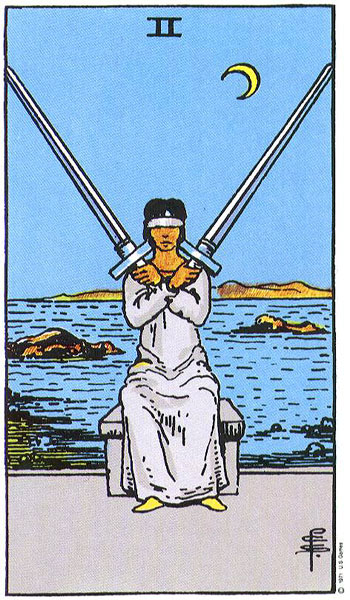
Of all the suits of the Tarot, the swords tell the clearest story to me. The Two of swords is the beginning of that story (the Ace is more like the title page), and it's the sort of story that begins with a precarious balance, or as Arthur Edward Waite calls it, an equipoise. There are two kinds of peace in the world. There is the classical kind of peace, the sort that lasts and is deeply felt, the peace of doves and cherubs. I can conceive that such a peace exists, but have absolutely no personal experience of it. I have no thoughts that I'll ever attain it, in fact, because such a peace would involve being at peace and contentment with myself, and I do not have the capacity to be a good enough person to not be a bad person in the net gain, and I cannot feel at peace with myself if I'm not doing more good than ill in the world. It's that simple, cards that talk about this kind of peace are beautiful, but utterly distant, like Dante looking into Paradise. The other kind of peace is the sort we actually see - moments of rest, moments of stasis, when all the forces inside have been, for just a second, precariously balanced against each other. This is the two of swords. The lady holds two painful,destructive forces in her hand, and sits on the edge of the precipice, but for just a moment, for just one transcendent second, she has put those uglinesses (a sword, like any instrument of war, is intrinsically ugly)up as counter weights, and for a moment, she can feel what it is to be still.

Those are my dearest moments, the moments when all the demons are balanced against each other, the moment just before another demon comes and the balance is lost - and it's the moment where I can choose, my little moment where I can decide to be good or ill. The precipice is always there, and I always fall, but I can regress, or I can journey on to the next card in teh swords: the Three of Swords, another of my favorite cards, the circumcision of the heart.

EDIT: BTW, since I know a number of folks have talked about wanting to learn about the tarot, I can recommend this page, which is a good introduction to how to read tarot cards. Additionally, if you just want to play with the idea without actually buying a deck, this page will draw you a spread, and links back to the descriptions of the cards and positions from Arthur Edward Waite.

Read More......

7.04.2009

Look for America (Weekly Geek 2009-25)

If you are an American citizen, share what the Fourth of July means to you and how you celebrate it. Do you think of it as the true start to summer? If you are from another country, other than the United States, share what national holidays are significant to your country. Are any of them similar to our celebration of Independence Day? Are there traditions around their celebration? Do they suggest the beginning of a season or something other than the National purpose? Go a step further...let's talk books. Have you read a good fiction or nonfiction book which centers around a country's search for independence? Do you have any book recommendations which embody the traditions or celebrations of your country? And since the Fourth of July brings to mind summertime ... are there any great summer reads you are looking forward to reading over the next month or two?
America is wonderful. That's the fundamental fact. There are few words in the history of the world that have become so universal, and so widely inspiring of wonder and amazement. It's been so for a long time - De Tocqueville was already raving about what America meant as far back as 1835, when America had hardly decided what she meant, herself. By the end of the century, thousands and thousands of souls crowded into boats, armed with little more than the one word: America. They could not even say it, sometimes, in proper English, but they knew it with the intimacy of lovers. I recently finished reading "The Jungle", a book deeply engaged with the word 'America.' America, the land, was a hell-hole unless you were rich - if you didn't have America, in short, you wouldn't get it by going to it. You'd simply be given a scrap to live in and the dubious task of fulfilling the America of others. When I was young, I heard the standard histories of this, that America was there, but that some people were frightened of a big-tent America. That, these immigrants came, and it was hard, but they, too, got their America. American history is a long, gentle bloom of revolutions: slaves were freed, then suffrage, then immigration, World War II, Civil Rights, the Feminist Movement. Manifest destiny was not, in my mind then, a slow growth of borders, but a slow destruction of them, towards the day when all men might, eventually, be free and equal, be truly in America. As I grew older, I learned better. I learned that America was always a sham. I read about the Trail of Tears, and realized the Native Americans were now just shoved into miserable reservations where they relied on casino money. I learned about the Ku Klux Klan and the virtual reenslavement of blacks that still hasn't fully been undone. I saw the way Hispanic immigrants are treated today, and I learned about the ways we keep ourselves rich now - we've just moved our slums into China and the Third World. There is no America, only a big lie told by the rich to sucker the poor, a complex kleptocracy as insiduous and cruel as the worst excesses of kings and emperors. Can you say that America exists or does not exist? America is not and never was a place. When I think of the Fourth of July, or when I think about the election last year, or when I think about the American flag, I think of a poem by Langston Hughes, one of the most beautifully honest works of patriotic literature ever written:
Sure, call me any ugly name you choose-- The steel of freedom does not stain. From those who live like leeches on the people's lives, We must take back our land again, America! O, yes, I say it plain, America never was America to me, And yet I swear this oath-- America will be!
(The entire text is available, for instance, here) A holiday? Perhaps. Perhaps in the old sense, of a holy-day, not holy for what we've done, but holy for what we meant, and what we've dreamt, and what we may yet do. That's America to me, and I do very little on the Fourth. I will light fireworks, when every man, of every nation can say the word, without the veil of distance or ignorance, like an epithet, like a cry of it's own particular meaning. I'll light fireworks, when there is only one America, when the America of the grafter and the world-leech is gone, when America is not just a nation, but an honest, pure feeling. I'll light fireworks, when what cannot be done is done, when finally, we have stopped waiting for the world to hobble on through history, and have drawn America up to her feet again, and crowned the good, so often forgot, so often ignored, with brotherhood, sisterhood, fraternite, ahimsa, agape, metta, or whatever word each local tongue can dream.

Read More......

4.29.2009

Three Foolish Virgins

All good and faithful servants stand,

The bridegroom waits to take thee home!
His hands are soft, his cloak is warm!
Don't pity we slatterns who've drained our lamps -
Ye kept your light till morning's come!
So stand, ye wiser virgins, stand!
Lift up your hearts, ye mild and meek!
But turn back, livers of lamplit lives -
If only thou'd strived with a little less strife..
But ye faithful - a chariot waits for thee!
Ride on, thou pitiless, preening Christ,
To victory! To victory!

------------------

I felt a cinder fall on me,
It burned me to the quick.
The flesh below was raw and clean,
The blood was pure and thick.
If thou hast mercy, sacred god,
Leave me when thou adjourn.
My sins are all that's left of me -
Pray leave them here to burn.

-------------------

The richness of the ambergris!
The smokeless spermaceti flame!
The ringing of the bells!
Here, sisters, take a little oil -
My lamp is rich and full of fat.
I cannot leave here - knowing that
You cannot come as well!

Read More......

2.24.2009

Why I name things

When I was in high school, my friends and I used to have gargantuan conversations late night on the bus, on the way back from trips with the marching band usually. I miss that. Late in the evening always makes me think. Most nights, anymore, I'm not up late enough - I hate to keep other people up by thumping around the living room with the light on. I'm only up tonight because I'm finishing the manicotti for tomorrow. I was at work today, and I felt a terrile pang of creation-hunger, that feeling you get when you wish you were making something. Luckily, I've had time to program at work, sometimes - I'm working on a rather large project that will legitimately save a lot of time and money, so I don't THINK I'm just messing around for fun. So I worked on it today. It's a huge undertaking, with many different parts. Arturo, who's been helping me with it, laughs at me for my part names - Siegreud, Brunhilde, Fafnir, Ydun, so far. Eventually, there will be a few others. The names, of course, add little to the project, and to be perfectly honest, when I've named things in the past, the names have been stripped out by management before release. But I love naming things, and I spend more time probably than I should. There is something to naming a thing that makes it alive - not because you've added anything specific to the thing - it's still, in this case, just a lump of Ruby code - but rather because it awakens something inside of the namer, something of connection and reality and relationship. You cannot have a relationship with "Lifecycle Management Project - Systems Management Server Interface 0.1alpha", even if that's a more 'accurate name.' You can have a relationship (sort of an imaginary friend relationship, but still) with a Fafnir - and it's a very expressive, honest relationship as meaningless as it is, and one that I would argue is important to our well being. We, as human beings, have come to a place in our lives where we spend a great deal of time intimately intertwined with inanimate things - machines, ideas, cubicles, rooms, houses. I'm not a Luddite, and I am continuously excited about what the future of humanity is with these things, as dangerous as they are - but I do think that we lose something when we become too practical. IT is easy, when it is possible to design a thing for efficiency, to lost the sense of divine whimsy that makes us human. I cannot be whimsical with a thing that has no name, and the naming itself, in all it's whimsical idiocy, is a sort of quiet revolution, a transformation of the mundane into the divine, the act of integration into the most godlike of human behaviours - to make a thing that never was before, a thing with a soul, or as close to it as I can manage. Golems are slaves, and so I agree wtih the Frankenstein myths - they are wicked evil things. But a friend? A secret? These things are good, and if humanity has come to a place where we can create machiens that let us feel real things, then I believe humanity is doing fine.

Read More......

1.18.2009

Sunrise/Sunset

 Image: 'The Evening Star', by Alphonse Mucha - Coming up this week on the inaguaration of Barack Obama, I'm reminded of a rambling nonsense post I read months ago after the election. Did ou ever notice that Obama's logo, the one that designers love so much (with good reason: between the logo, the font choice, and the iconic poster, Obama's design team, official and ad hoc volunteer, single-handedly brought beauty back to propoganda) centers around the image of a rising sun? Until they had the big infomercial at the end of the election cycle, and I saw the logo animated, I was always struck that it could be a sunrise or a sunset (presumably, depending on whether you face East or West while wearing the shirt). I like it better that way - not that I think it would have been a good idea to leave it ambiguous as a conscious campaign choice, mind you, but still. I still believe that is what this presidency is all about, it's about deciding whether we are in the evening or morning of America. Which got me thinking, more generally. A few years ago, I read a an article, one that I admittedly didn't particularly enjoy, talking about how Star Wars and Lord of the Rings were wrong-headed, essentially psychogically damaging books, that said that the future is a future of devolution, of humanity eventually having to fall back to the mystical as reason fails them, a dark period of 'science' (think the great factory-land of Mordor, or the Death Star), that is weakened to a mere passing of a golden age by the intervention of magic and god. He said these stories are gloomy, and ignore the manifold truth that science, reason and the like are making life wonderful - books, according to him, like Asimov, or his own novels (I think it was David Brin that wrote it), or Star Trek, these were what we needed to write, hopeful novels that grasped onto the humanism of the times as a road to progress as yet undreamed - the new, cheerier Ubermensch, as it were. This strange dichotomy of sunrise and sunset has stuck with me ever since - while I don't necessarily agree with his conclusions, this duality in American thought exists, has existed, as far back as Emily Dickinson and Walt Whitman, or the cheerful hope of Manifest Destiny, by Chief Joseph sadly laying down the past to the past. And, it's there today, the mixture of our assumed world omnipotence, with our hopeless retreat into Depression (economic and otherwise), in films like Titanic that celebrated the essential American idea (although that argument coudl be aa whole other blog post) and films like The Visitor, tha tshow us in ugly relief how inhuman our self-reliance and can-do spirit can make us as a collective body. So which is it, where are we, we Americans? I think what the commenter missed in his thoughts on Lord of the Rings, is that Tolkien knew what comes at the end of an age - a rising and a setting altogether. IF the stars fall, it opens the way for the sun, and if the sun falls, it whispers back to us off the face of the moon. Galadriel passes, but Arwen arises. It is the choice of the workers of the forge of history what comes next, what sort of day or night we'll enter in upon. I wonder if the people in other countries feel this way, now, if a country in ascendency, like India, has different spirit to it, if there is a setting there, beside it's rising. I wonder if the people in the Revolution felt a farewell in their hearts to the age of kings, even as they ushered the age of the republic. I wonder if this is just how it feels, to be in a nation about to die or live, or both.

Posted by Picasa

Read More......

12.25.2008

Oh to be a little match-seller!

Christmas is here. I don't like Christmas, I don't think I really ever have, though there have been times when liking the accoutrements has outweighed disliking the holiday. And I do like some of the accoutrements. My dislike of Christmas is not due to people obliging you to buy presents, or anything like that (though I do hate feeling bombarded with advertising, but that's all year, and the price of living in the modern world, a small price to pay). I love Christmas music - this year I memorized all the words to 'Need a Little Christmas', which is, by the way, kind of a weirdly poignant song, in it's way. I even have a strange desire to someday make a fruitcake. In fact, I might even say that I DO enjoy the month of December, just as long as I can manage to keep away from remembering that it ends with Christmas. But the reminder always comes back. There's something terrifically lonely about Christmas. I don't pretend that's a universal sentiment - one of the things I LOVE about Christmas is that it seems to make other people so happy (sometimes, anyway... and we'll leave it at that ;) ). But there is something, I even remember when I was about 10, the feeling of finishing opening the last gift, and feeling a sinking sense of hollow isolation - the feeling itself isn't odd, but the unique pang of this particular hollowness is special and particular to Christmas, completely irrational, I don't why it feels this way. Christmas is a sort of day of existential loneliness. Even from a logical point of view, it always disturbed me. When I was a child when I struggled to believe in Jesus Christ in the way that all the people I loved seemed to believe, I remember thinking it was a sad sort of holiday, to sing praises of joy that our brother had descended from the bliss of the heavens, to be born in squalor, live in misery, teach in rejection, and die in agony. Hurrah! Jesus has come to die, because I can't manage to never screw up! I don't mean that sacreligiously, I just never felt like it was a happy idea - I mean, sure it's a feeling of relief, but not 'Joy to the World.' 'I Wonder as I Wander,' which my lost friend Sarah Kortemeier first sang to me, in High School - that's what Christmas felt like, a sort of guilty, lonely penance of a day. A part of the final judgement I always imagined would be that God would place before us all the joys we wanted in life, show us all the good we kept from others for the sake of our own pleasure, and then tell us to eat up, while we watch the sorrow we avoided. That's how Christmas feels to me. Anyway, enough of that. I woke up yesterday, with a lead heart, and a swollen self-pitying blah-blah-blah in the back of my throat, and then had to go to work. By the time 1:00 rolled around, I knew that it was time to pull out my secret weapon - the Little Match-Seller, by Hans Christian Anderson. I love this story. I don't know where I first heard it, except that I was young. I expect it was from my mother, who I seem to borrow from a lot in terms of my personal taste (thank goodness), because whenever I read it, it's easy to imagine my mother crying (if any of my siblings read that sentence, they'll probably chuckle at the idea of mom crying at a Christmas story being peculiiar. If my mom reads the same sentence, she'll stick her tongue out at them. Dad, on the other hand, will probably wisely just feign smiling ignorance). But I remember liking it, that's all I remembered for years, until sometime in High School, when, between less-than-Christmasy internet browsings, I remembered this story, and went and looked it up, and cried my eyes out. It was wonderful, and made me feel much better about Christmas (I think that's the same Christmas where I peeked under the tape on all the presents and figured out all the gifts to me before Christmas came, and then bragged about it too loudly and probably hurt a lot of feelings. Sorry, Jeremy in particular, and while I was way too cool to say so, the Chia Pet-type present would have totally rocked...). I never really knew why, though. It's not the 'happiest' story in the world. This year, though, I've figured out the trick - in all of Mr. Andersen's best stories there's a trick. And the Little Match Girl? It has a great trick. When an adult reads a fairy tale, they (generally) seem to read one of about three things into it: either it's an extrapolation on an adult issue, that's too big for kids to understand (think people writing about Sleeping Beauty as a metaphor for sex), or it's a way to affirm values that we adults already (should) have (take, say, Little Red Riding Hood), or else it's a way to escape from being a grownup, and just be a kid. And, the thing is, you can do any of these in this story if you want. That's part of the trick though, because the story is none of these things, at least not the part that gives me a little peace at Christmas time. The beauty of this story is, much like the book Peter Pan, that it is a story that acknowledges a real, instead of an imagined, power, available to a child, an adult, or any other soul, and it's the sort of power that we, especially we grownups, do not like to acknowledge. As adults, when a child dies in a story, we want it to be heart-breakingly beautiful. There are good reasons for this - after all, if a child dies, it's a miserable thing. But the truth of the matter is, that having a child be perfect when they die is, sort of, easier for us. It lets us out of thinking about it. It lets us think the child is, sort of, symbolic, angelic. Beyond human control. The child is the consummating, terrible sacrifice, that lets us feel our internal catharsis, without having to face anything new. This is the easiest way to interact with tragedy and childhood, two ideas we do not like to mix. But, the problem with that is, we don't ever stop and realize why we don't like to mix them - there is a reason. I won't presume to tell perfect truth, but for me, at least, there's two. The first is the kind of reason that doesn't matter - it's not much fun to think of dead kids, and it's even less fun to think of dead kids dying miserable. Dead kids should at least be offered the dignity of being angelic. There is limited usefulness to making people uncomfortable for the sake of discomfort. I do not like ugliness for it's own sake, and dead children are inarguably an ugly thing out of context. The other reason... well, it's trickier, and it's very related, somehow to Christmas. Dickens fumbles at it in a Christmas Carol, when the Ghost of Christmas Present opens his robe to show the two children, Want and Ignorance, and he points out how ugly they are - not how dirty and miserable, though these are there too, but how inutterably ugly. Scrooge isn't wracked with tormented pity, he's repulsed. The children look like monsters, with claw-like hands and ugly, hateful faces. This is why, when you see a movie with a poor orphan child in it, it's always a poor, waif-like little pale white girl, easy to love. You want to be able to love an orphan. Stories about terrible orphans, miserable, dirty orphans, ugly orphans different than we are, these stories aren't fun, because we don't want to have to feel bad about not loving them. And, as a side note, I imagine it makes it very difficult to be an orphan. And that's the funny thing about this story. First, the child is classic glurge - she's beaten, she's poor, she's tormented, she's pale and unhappy and lonely in a big world, and we, the readers, we can see what a dear sweet thing she is. Now, before the child dies, Andersen does his first trick, and makes the girl real. He makes her have real, individual little fantasies. We kind of conveniently remember her as just seeing, for instance, a big piping hot dinner (and this is my favorite humanizing touch), but in fact, she sees the goose stand up, all cooked, and walk toward her with the carving tools coming out of his breast. The sheer specificity of this feels human - it's something someone imagines, not something someone imagines that someone would imagine. Suddenly, we can't have all that distance, we're pulled in close, and forced to actually engage with this girl, and not just be the invisible soul on the corner, noting how sad it is. We are involved, we cease to sympathize for this girl, and begin to empathize with this girl. But, that's not the whole trick, because even then, it's just a particularly well-done piece about how we should realize that we treat other people poorly, in sheer ignorance. A beautiful story, but not as powerful as this story actually is... The last trick is, if you let yourself fall completely into this child, you realize that these things are real to her. It's not a delusion, it's not some cracked, miserable fantasy. The child is not powerless, waiting for us to save her. The child, deserted by humanity, proceeds to save itself, to create a world that is better than the one she lives in, and then, through sheer moxie, to will that world into being. The girl is not stupid - we see that despite being drudged into a life of misery and shame, she's still very creative, for instance. She knows what's going on, and she knows what, in our little limited world, sitting on that frozen stoop means. She knows the matches won't last, she knows she's settling in to die. But, when the star falls, she does not say it's hers. It's not ignorance, it's not delusional dullness. It's a refusal to be the character in the script that is laid out for her - she is not going to die, even if she does. She's not going to be a powerless, lonely orphan, even if she is one. When her grandmother appears, she could just let her go - she doesn't, she clutches on to her, and refuses to let the world pass. She has created what she wants, she has made it in her own mind, and refuses to return from it to the idiotic world that we grownups left her. And in the end, all of us foolish grownups, we're left to just tut-tut over a poor dead child, and cry and think it's so terribly sad - never realizing that we don't have the right to cry over this girl, we need to cry over ourselves. We're the ones who can't find our way to something better. Of course, that doesn't mean we should all commit suicide, or anything - the girl didn't kills herself, she just accepted that death was coming. There is more than one way to refuse to live in the world we're given. The operative word is change, and change can come many ways. One could be a Ghandi, for instance, but one need not be. Emily Dickinson created a world to her liking in a different way. So did some of the Mormon forebears I have in my genealogy. So did the Haitian revolutionaries. So do kids who make up imaginary friends. All we can do at Christmas is to fiercely defend our right to live another year - because it is the fierceness that creates the right. All we can do in this world is refuse it, but what power there is in refusal!

Read More......

12.22.2008

Anniversary

I don't write as eloquently or remember things as clearly as my wife, but if I didn't post SOMETHING, I'd feel like I was being unfair to my beautiful companion, that she wouldn't know how glad I am that she hasn't found anything better after so many years. Anniversaries are a time for arrogance, for feeling your love is so important that someone else can't do without it. The other day, I was putting together Amanda's anniversary present for this year - in classic Jason style, I then blushingly left it on her desk for her and went off to scrub the kitchen counter or something, never telling her why I gave it to her for her anniversary. This year, I found a card box, some Hallmark device in which you're supposed to store all of your treasured old Hallmark cards (presumably, if you try to slip in an American Greetings card, teh box looks at you in disgust...), down at Big Lots. It's not the nicest box, I in fact, had to use a bit of masking tape on it, but Amanda has, presumably since long before she met me had a little square box in her closet, an old battered cardboard recycled box. Inside, she had all her old letters from her best friend Natalie Tiftickjian, nee Salazar. To m e this box always had a sort of mystical quality to it, like, if I touched it, I'd mix something up and forever damage my wife's carefully orchestrated organization (in my defense, I've done this before, in other places, with that result, I think...). But I always felt sorry for those letters, all stuck in a box for something that looked like an Amway product, forever anonymous amongst the other knick-knacks in her chest. I've met Natalie a few times, and usually feel uncoomfortable during the meeting. There are a lot of very excellent reasons for this, historical issues that should cast absolutely no aspersion on Madame Oddstockings as I dubbed her in my brain a long time ago (I don't remember why, now). None of the excellent reasons were really the reason, though. When Amanda and I met, there was a peculiar fire to her, a powerful force that drew me to her, and in those halcyon early days, I basked in it, a funny, tired little thing, and for some reason, she let me bask, even liked me to bask there, to warm myself in her. I fell in love with that secret sun first - the rest of her I've fallen in love with since, in teh slow, quiet way that one falls in love with a beautiful, subtly discovered soul. Shortly into our marriage I, again in classic Jason style, mucked up this lovely light more than once. It's still there, I see it flash once in a while. I don't think I'm, in fact, sufficiently grand to douse a genius like hers. But, I think she has learned a reflexive care with it, now. Natalie is a sort of moon to that sun, something distant, and impassive towards me, but that when it passes through the sky (always, Amanda will attest, with an infrequency that fate seems to have, until recently ordained for their friendship..), it shines a soft reflection of that same halcyon beauty. I've always appeciated Natalie in Amanda's life, because it's a sort of reminder to me that Amanda is eternally precisely what she is, a sort of redemptive ignominy over any mistakes I might make toward my wife. It's hard to explain, and I'm probably botching it up wildly, but it struck me with a clarity the other day, because it was Susan Dickinson's birthday. Emily Dickinson is my one constant over the years. Since early high school, through all the myriad stupid, flighty attempts at various ways of living I've made, through the many transmutations of my identity, Emily Dickinson has been the only thing I've always loved (Amanda would be the one exception, and a stronger one at that, but I happened to meet Emily Dickinson before Amanda... ;) ). She's always been a sort of ideal to me. When she was alive, her best friend, her most frequent correspondent, and her oftimes poetic editor was her Sister-in-law and neighbor, Susan. The letters that she wrote Susan (almost none of the return correspondence survives) are some of the most beautiful examples of Dickinson's writing, and their relationship had a depth that spoke to the intensity of both souls. I've never been a crusader for the theory that the two were lovers (more or less, it's always struck as irrelevant and distracting from what really matters abotu the relationship), but the intensity of their friendship is such that I don't think you can really fully understand Emily Dickinson if you don't look at her relationship with her neighbor. It's the sort of relationship I've seen so seldom that it's difficult for me to really desribe it or comprehend it. Anyway, as I was thinking about this, I realized that, in my mind, Natalie is Amanda's Susan Dickinson. So, I really didn't mean this to be a long diatribe on Amanda's relationship with her best friend - honestly, I've not read there letters, or been privvy to most of there real conversations, and most of my thoughts here are probably pretty clumsy approximations anyway. What I really mean is that, this surprised me for a moment, because I realized,that I think of Amanda in the same way that I think of Emily Dickinson, someone who is beyond mere humanity, mere momentary affections, someone to large for the love of any one soul, but someone at the same time so intimate, honest, deep and soft that she can be preciously, intimately mine, someone whose dashed off words hardly considered for content, can speak volumes to me deeper than the thought out speeches of most souls, someone with the sort of beautiful humanity that at once fulfills one's understanding of the nature of divinity in man, and gently chides you for thinking you understood it at all. So I made this box, because I cannot imagine that someday, someone won't find her, and have the deep need to know who she was. I'm no historian, but I can at least have a little clasped box for her, to put these letters in, so that someday, some little soul who loves what she leaves the world behind can know her well enough to love who she was when she was here. Anyway, thumpedy-thump, blah blah blah. Here's hoping that doesn't sound too crazy. I love you, Amanda.

Read More......

11.05.2008

America's Better History

I've watched elections since I was a kid, so while I don't have a long track record, I've paid attention as long as I've been able in my small life. Never have I felt as excited about a president getting elected.

And never have I felt as vulnerable.

Americans have never really recovered from the wounds of the 60's and 70's, especially of Watergate, from the feeling of betrayal and irrelevance towards our highest leaders. The bleeding is past, perhaps, but we never really cleaned the wound, and it's a festered scab, now, occaisionally oozing out the infections of the past. America has become a cautious wife, and caution has, over and over, shown up lies, discrepancies, uncleanness, and continued unfaithfulness, in both parties, with almost every president since Nixon. Suspicion and caution have largely transformed into cynicism and sublimated frustration. What's the point, we say? The old couple will stay together until one or the other dies, but the love is gone.

That's why this election is so important to me, on a personal level. Maybe it's the passing of the baby boomer mantle, maybe it's just the healing power of time, who knows - the power of this election has been that people can look to the new president and feel investment, kinship, hope. America has, in some small way, reached a timid, hopeful hand out to try to repair the old, broken marriage between public and government.

I like Barack Obama. I voted against him in the primaries, but I am glad he won. I feel a small tendril in the wave of hope that America hasn't felt in a long time. I know there are those who think this is simply a hope that government will give us things, that government will bend over to the interests of this or that specific issue. I don't agree - the people who spent countless hours, countless scanty dollars, and internal heartache and investment into this race cannot simply be working on a quid pro quo basis. This is not a Jacksonian presidency. These people love and hope and dream, mostly, guilelessly.

America has kvetched and mocked for years about segments of society - youth particularly - that just didn't turn up at the polls in the same numbers as the reliable groups: union members, older people, rich white people, evangelicals, etc. I remember hearing the requests, and the civics lessons when I was younger, the condescending talk of how your vote matters, told like some sterile storybook that the reader couldn't really even buy into. And then, in the real world, the prevailing wind in politics was that you were picking between the lesser of two evils, that both parties were the same anyway, that you could depend on whoever gets elected to break all their campaign promises, cheat, lie, and act like a dog. The only person who'd want to run as president must be crazy or power-hungry. Culturally, we lost a general faith in humanity.

People don't like to live like this, why would they be interested in getting engaged in a complex process that leaves you emotionally hurt if you lose, and even more emotionally hurt if you win and your candidate deserts their ideals?

Barack Obama's victory is not a Democratic victory. After all, what if, say John Edwards had been the winner? We'd be starting his term finding out that he was diddling one of the campaign staff while his wife stayed home trying to fight her breast cancer, and subsequently lied to the American public about it. Yay Democrats! It's not a victory for liberal ideas - frankly, I wish he was a bit more liberal than he is, though I'm sure that's not a universal sentiment. If it was ultra-liberal politics that America wanted, we'd of elected Ralph Nader or Dennis Kucinish or something - not-so-stellar choices, in my opinion. It was not even Barack Obama's victory - the man is just a man, and aside from the Obama girl video, most of the excitement I've heard has been around the empowerment of all the little people working for him. It wasn't even the normal populist victory, of people who are mad as hell and don't want to take it anymore. It was none of these things. The victory of Barack Obama is the quiet voice of a people who desperately want to trust again. Americans don't just want to stop being ashamed of where their government is going, they want to start being proud of it - they want to start being PART of it.

During the Cold War, America had a compelling (if somewhat deceptive) story - it was the vanguard of democracy, facing an evil empire of communism. I remember when the wall came down, pundits made a lot of noise that America does not know how to not have an enemy. I understood that at the time, and it came true, has continued to come true - we have tried our hand against a number of different enemies. But here's the great irony - we finally found one, the perfect enemy, because it's one that will never, ever completely go away, in the attacks on 9/11. We, as a people, could, if we wished, delude ourself into a story where, forever and ever and ever, we stand on the right side of a battle against terrorism, extremism, or Islam, depending on the teller. This could cease to be one of our struggles, and start to be our identity.

It worked, for a while, but at some point, America started to lose it's stomach for it. The voice of cynicism tells me it's because the conflict was headed by complete dunderheads, and because America no longer has the stomach to be at war. But I think this is a lie, the sort of comforting cynicism that we make up to keep ourselves from destiny. America is just past the point where it can accept the idea of black-and-white battle as a defining national characteristic. So the war drifted, Bush fell apart, and America came into an election season desperately seeking for it's own soul.

The election, to me was simple. The gaffes, nonsense, vagueness, news stories, and everything else, were never important in and of themselves - it was simply that one side felt like a dream, and the other felt like an assurance that nothing would have to change. I wanted to dream, again, like I ever had, but again, nonetheless, like in the poem by Langston Hughes:

O, yes,
I say it plain,
America never was America to me,
And yet I swear this oath--
America will be!

And that's just it, that's why I feel so vulnerable, and why I think a lot of Americans, particularly younger Americans (other groups, I don't know, I can only speak for the ones I know) are feeling the same way. I didn't just let Obama have my vote - I gave it to him. And he promised me, in a more directly personal way than any politician has managed to in a long time, to use it to create a dream that he is not possibly capable of creating, but that he needs to create nonetheless. It's not just 4 years at stake. This isn't a trial run. America in her ancient wisdom knew it was time to be a dreamer again, and dreamers do not make backup plans or hedge their bets, they succeed or fail, gloriously.

I read this post, by a programmer I keep a stray eye on, who talked about America needing to be like a good engineer - optimistic in the way that makes you fight to do things that seem impossibly complex at the beginning. Read the article, he says it much better. Of course, we're not the first nation to try this, to try to become what we dream. France, for instance, tried it out in 1789, and ended up murdering huge swaths of it's own population. No great power has ever lived through this stage of it's development, because it either refused to throw itself into the void, and slowly dwindled away into irrelevance, or it threw itself into the void and fell and fell, not strong enough to fly. This is easy to explain, easy to understand - no  nation is really a narrative, it's a collection of people, full of warts, fears and imperfections, unified only in a desire to not have to worry about things, led by men who desperately want to make sure they don't get replaced. Men fly, on occaision, genius happens on the individual level, but a nation? A nation is too big, too cumbersome. It's an endeavour in which it is impossible for any nation to succeed.

It's time for us to succeed anyway.

Read More......