Showing posts with label wonderful people. Show all posts

3.01.2011

Happy Birthday, Amanda!

Today is my favorite person's birthday! We actually alll really wanted pizza yesterday, so we did a party and presents a WEE bit early, but still - HAPPY BIRTHDAY AMANDA! Go visit her over at the Zen Leaf and wish her a happy birthday.

Otherwise, sorry to have been missing the last two weeks. Will start catching up tomorrow if possible.

Happy Birthday, jewel of my heart! :)

Read More......

4.22.2010

Charlotte Mew

The district of Bloomsbury in London is a storied one, around the beginning of the century. It was the home of Vanessa Bell, from which came the famed 'Bloomsbury Group' that included her sister Virginia Woolf (who also spent time living in Bloomsbury) and many other of the leading lights of the day. J.M. Barrie lived there when he arrived in London (the home where he lived, supposedly, is the model of the home in the old Disney Peter Pan film). William Butler Yeats made Bloomsbury his London home. Dorothy Sayers spent the greater part of the 1920's there. It is, even now, the home of the British Museum, as well. It is strangely fitting, then, that in 1869, when Karl Marx would have been studying the workings of Capitalism and the transformations of the Industrial Revolution in the British Museum reading Room, that in this same neighborhood, the poetess Charlotte Mew was born. Charlotte Mew was the daughter of Frederick Mew, an architect (the trade runs deep in her blood, her grandfather and several other relatives shared the calling), who, later, died without leaving enough money for his family. Four of the Mew children lived into adulthood. Mew's brother and one of her sister's were admitted into institutions early in their grown years. Mew herself, and her remaining sister, Anne, made a pact with each other never to marry, for fear of passing insanity down to their children. It was, thus, outside of the confines of the traditional Victorian family and in somewhat straitened circumstances that Mew spent her adulthood. Mew, in many ways, is a British Emily Dickinson. In the same way as Dickinson, Mew wrote poetry that was, frankly, unclassifiable and incomprehensible in it's time, from a position of relative solitude. She formed intense friendships with several women (most notably, it seems, her sister and Emma Hardy, the wife of author and poet Thomas Hardy), and otherwise lived a life of almost pathological privacy, actively working to make sure there was as little biographical information on her as possible at her death. And more than anything else, like Emily Dickinson, she was a poet with a startling, powerful vision of what it is to be alive:
The Peddler

Lend me, a little while, the key
That locks your heavy heart, and I'll give you back--
Rarer than books and ribbons and beads bright to see,
This little Key of Dreams out of my pack.

The road, the road, beyond men's bolted doors,
There shall I walk and you go free of me,
For yours lies North across the moors,
And mine lies South. To what seas?

How if we stopped and let our solemn selves go by,
While my gay ghost caught and kissed yours, as ghosts don't do,
And by the wayside, this forgotten you and I
Sat, and were twenty-two?
Give me the key that locks your tired eyes,
And I will lend you this one from my pack,
Brighter than colored beads and painted books that make men wise:
Take it. No, give it back!

Mew lived in a strange, transitional sort of poetry, halfway between the Victorians and the Modernists, and at the same time neither of these two things. Her poetry almost feels the prophetic echoes of a future, in the same way that you feel the coming echoes of the Romantics in a poet like William Blake.

Her main publication was 'The Farmer's Bride', at first a very short collection of poetry, but later expanded to include several other pieces (the version on Gutenberg is the short one, I'm afraid, though if you want to listen to them, the long version is on librivox in audio form, and read quite well). The book was never extraordinarily popular, but drew praise from many luminaries of the day. Thomas Hardy considered her the best female poet of her age, and Virginia Woolf called her "very good and quite unlike anyone else" (which, from Virginia Woolf, is high praise). She got a small government pension and lived frugally, putting out several other poems over her life.

No shadow of you on any bright road again,
And at the darkening end of this--what voice? whose kiss? As if you'd say!
It is not I who have walked with you, it will not be I who take away
Peace, peace, my little handful of the gleaner's grain
From your reaped fields at the shut of day.

Peace! Would you not rather die
Reeling,--with all the cannons at your ear?
So, at least, would I,
And I may not be here
To-night, to-morrow morning or next year.
Still I will let you keep your life a little while,
See dear?
I have made you smile.

In 1827, her sister Anne died. Charlotte was broken. Several years earlier, the sister in the asylum had died of tuberculosis, giving Charlotte a great fear of germs. Anne's room, at her death, was found dotted with black spots, which Charlotte felt sure were the cause of her death, though a coroner declared them to be simply soot from the London air. Charlotte grew increasingly disturbed, and several friends suggested gently that she admit herself to an asylum. She refused, but did eventually go to an asylum, where her phobia of germs grew stronger, still. In 1928, Charlotte Mew was found dead, after having drunken half a bottle of Lysol.
The Changeling:

Toll no bell for me, dear Father dear Mother,
Waste no sighs;
There are my sisters, there is my little brother
Who plays in the place called Paradise,
Your children all, your children for ever;
But I, so wild,
Your disgrace, with the queer brown face, was never,
Never, I know, but half your child...

Sometimes I wouldn't speak, you see,
Or answer when you spoke to me,
Because in the long, still dusks of Spring
You can hear the whole world whispering;
The shy green grasses making love,
The feathers grow on the dear grey dove,
The tiny heart of the redstart beat,
The patter of the squirrel's feet,
The pebbles pushing in the silver streams,
The rushes talking in their dreams,
The swish-swish of the bat's black wings,
The wild-wood bluebell's sweet ting-tings,
Humming and hammering at your ear,
Everything there is to hear
In the heart of hidden things.
But not in the midst of the nursery riot,
That's why I wanted to be quiet,
Couldn't do my sums, or sing,
Or settle down to anything.
And when, for that, I was sent upstairs
I did kneel down to say my prayers;
But the King who sits on your high church steeple
Has nothing to do with us fairy people!

Read More......

3.23.2010

Ada Byron Lovelace Day: Susan Kare, Graphics Pioneer

Happy Ada Byron Lovelace Day! I've been mentioning this around to a number of folks, but a group of very nice people have been organizing today as a day for people to talk about some of their female heroes in science and technology, to raise awareness about women in these industries (where they're sadly underrepresented :/ ). There are SO many women I could feature here, so many great heroes, I just wanted to mention one of my personal favorites, and why. I work in computers, as many of you may know, specifically with Macintosh computers, and (now, please, no political arguments), one of the reasons I like working on the Macintosh is because, since it's inception in the early 1980's, the Macintosh has worked hard to make itself beautiful. Pretty. Call it what you will. Some people call it cute, or fluffy, or showy, or whatever. I call it beautiful. I am NOT someone who is good at making beautiful things, but I love beauty - it is beauty that, in the end, helped me to be okay with my career path. In the modern world, we spend enormous amounts of time in a world entirely of our own construction, one made of devices, files, graphics, data streams. This is no longer just somewhere geeks and techies spend their time, it's a home to people of all stripes now. Yet, in spite of the amount of time we spend on these devices, we do not think of any of this as 'real' - and therefore we tend to just think past the computer, to attempt to ignore it and marginalize it in our lives. Working for a large corporation, I see this all the time. Computers are tools. We treat them something like enormous staplers - only staplers burdened with a great weight of machinery meant to make sure that the user doesn't accidentally waste staples, or staple their hand. A computer - or more accurately, a virtual world, since a computer is mroe than simply a box - is more complex than this, it is, temporarily the home of one's consciousness, often for hours and hours at a time. It is an office, a lounge, a night club, it's many places rolled into one place - a place designed not for users but for managers, for profiteers, for technicians. I find this very, very sad - to me, my duty as a computer worker, is to give the people I work with somewhere they can be happy - at least a little bit. A computer should be a place that listens to you and acts the way you'd like it to, rather than one that retrains you into being something you're not. Of course, huge strides have been made in this area over the last 30 years - and Susan Kare is one of my heroes in this work. Kare is a designer, her portfolio is available, in part on her website. Flipping through that portfolio, for an old geek like me, is something like looking at your childhood picture album. On the Mac, she designed most of the original icon set, things you take for granted now - things like the happy mac and the bomb icons one used to see on startup, or the command key logo that's on an Apple keyboard. She designed the Monaco typeface - the one that, for instance, was the text on all of the original couple of generations of iPod. She design Moof the Dogcow - which, if you don't know Moof the Dogcow, you should look it up, because it's a happy, happy little bit of joy. And that was just it - in a world where computers were beige and bland and meant to feel like accountant's tools, the little splashes of life that Ms Kare designed were whimsical, playful, and very, very human. On Windows, she designed the cards in Solitaire. Most of her most famous work is not used anymore - or it's used in a highly refined form. Part of the beauty of her work was her ability to render ideas with clear meanings and a distinct soul in the kudgy, bitmapped screens that computers had when she was building - 8 bit color, drawn one bit at a time. While her icons themselves are slowly dissapearing or being reformed, the spirit behind her work is still a guiding principle across the computing world, and one that is growing more important today: that a computer should speak to humans, should help them to relate to the unfamiliar, should be beautiful, and fun, and simple. The visual look of the iPhone - simple uncluttered design with subconsciously recognizable, bright iconography - owes an immeasurable debt to Susan Kare. Every graphical operating system - Windows, Mac OS X, the various Linux desktops - looks and feels the way it does, at it's best moments, because it's imitating the successes that Kare was such a part of in the beginning. Susan Kare is one of my heroes in technology. She didn't invent the microchip, she didn't program the Linux kernel, and the work she did is largely defunct now. But what she DID do was, in a culture of insular, excited technospeak, whisper out in her little way about people, humans, and about the noble reality of a geeky, copper-wire dream - that computers are more than table saws, they are ways to live more fully, more completely, and more beautifully.

Read More......

1.26.2010

Florence Nightingale


(The below is a sort of boiling down of some of the notes I took reading a recent biography of Florence Nightingale. The biography itself was excellent, I literally marked about 90 different places that I wanted to go back and sketch notes from. If you'd like to learn more about her, I highly recommend it, it's by Mark Bostridge)


After a week on the Nile river, Florence Nightingale's dress was crawling. Sand, heat, slithered up and down with each movement, and despite the tortuous confinement to the cabin, vermin probably shared these chases. To Florence, the filth was secondary - or more, the filth was symbolic - it was the tenuous fingers of the shoreline reaching to her, the shore where she saw men live in hovels to low to stand up straight in, digging through the refuse the tourists dropped off to support a meager diet, killing and dying like animals.


The idea of this was horrific in the immediate, of course. Florence, more even than most men at the time, understood the effects of poverty on health: mental, physical and spiritual. She was a statistician, a woman who would write glowing letters of thanks when she received books of government figures from friends, a woman who, upon meeting a mathematician a few years after the trip to the Nile, played the part of an awed worshipper. The spread of souls dissolving slowly into their own filth was a series of figures, a math problem with a very definite final product - death, decay, degeneration, the transofrmation of man into beast.


But, for Florence, it was more than this, for Egypt, to her, was history itself, was a portrait of a lost cause of God. With a sense of religious universalism uniquely her own, Florence saw the gods and progress of the Egyptians as reflections of the same truths she learned in terms of Christ and the Abrahamic God: after visiting the Temple of Isis at Philae, Florence had snuck back alone, to lie her crucifix in the sandy floor of the chamber of Osiris. For her, the call of Shelley's Ozymandias wasn't destiny, it was a warning, a spur to strive and strive, so that the monuments of her day would not dissolve slowly into the earth of England, so that her people would not stoop down again, to pick at the refuse of a future struggle.


The overpowering presence of Egypt for Nightingale was in it's brown-ness, it's sterility. The weight of the endless, hopeless stretch of the Sahara fell on her through the narrow windows of her cabin, mile after mile. The ship itself they had named Parthenope, after Florence's sister - she embroidered a banner with her sister's name, and it flew behind them in long, neat greek letters - the banner can be seen today, I believe in the British Museum. She had sewn it in good earnest, for the love Parthenope and Florence felt for each other had an intensity we would normally associate with lovers, not sisters - Parthenope herself was to say one day "I never thought to marry any one but Florence". But by 1850, as Florence sailed up the Nile, the fire of her sister's love - a jealous love by all accounts - had burned her almost to the very sterility of the desert. The trip had been, in part, to escape her home: a doctor was to proclaim that Parthenope's love for Florence was so intense that the two needed to be seperated lest it disrupt her own health. And Florence's mother and father struggled with the genius of their daughter, struggling, continuously to understand how someone in such a comfortable position could turn from marriage, could become so upset at the social world, at the drawing room (she was later to refuse to have a drawing room in her home, declaring it an instrument of torture for women). But Florence was simply not capable of supporting the life she was born into.


"Unconsiousness is all that I desire. I remain in bed as late as I can, for what have I to wake for? I am perishing for want of food... Therefore I spend my days in dreams fo other situations which will afford me food...


Starvation does not lead a man to exertion, it only weakens him. Oh weary days, oh evenings that never seem to end. For how many long years I have watched that drawing room clock and thoguht it never would reach the ten & for 20 or so more years to do this. It is not the misery, the unhappiness that I feel so insupportable, but to feel this habit, this disease gaining power upon me - & no hope, no help. This is the sting of death."


Her 'dreams of other situations' were more than simply the fancy of an lonely mind - they were intense, physical experiences, and experience at once addictive and dangerous. She compared the habit to 'gin drinking', said it sapped 'her vital strength', spoke of dreams and moonlight giving her a "A queer feeling... not to be quite certain of which is true and which is imaginary." The feeling persisted, even in Egypt, which was to be an escape from all of the lonely boredom of home: she described her hazy dreams as she floated the torpid Nil as her 'enemy', the 'constant murderer of my thoughts,' and abused herself as she felt the quickening force of the ancient splendor tug at her soul, for '[dreaming] even in the very face of God', begging God to free her from the 'enslavement'.


The weeks crawled, she dreamt and melted into teh slithering stillness of the river, or the hazy cabin windows, of her own skin. She left to shore to look at great and ancient sites she'd read of all her life, and dreamily wandered back on the ship, forgetting even what she'd seen. She read page after droning page of novels aloud to her companions, to the maid even. And then, just before they returned to Alexandria, she heard the voice of God.


To her, this voice was dramatic, and very real - and this was not the first time she'd heard it speak. She first heard it on the 7th of February, 1837, when it came and told her that she was to do a great and holy work in the world, to bring men closer to God. This closeness was, to her, not faith, in the sense of the CAtholic mystics, not a surrendering or even a worshipping action. Sanctity, goodness, was the process of digging out and discovering the laws of God, and following them - and this did not mean the Ten Commandments. To her, evil was all that made misery in the world, and holiness was all that made joy. To her, there was more godly law in discovering the laws of sanitation than in praying for things to happen. An enemy would later describe her sneeringly as finding Christ in a drainpipe, and it is a description that was not only apt, but for her, likely a compliment. This mixture of mysticism and practical effort was the very soul of her life - and as a result, the banal and the impractical were the enemies of her existence. God had called her to do, not to chat, to marry, to entertain.


The call came again there on the Nile, and her letters, previously almost daily letters, ceased for two weeks. Her journals paint this period as a long, Jacob-like, wrestling with God. At the end, she wrote that she had 'settled the question with god,' that, in the spirit of her faith, she had worked out what she was to do, not simply submitted in blind trust. In the ensuing week - a whirlwind tour of Greece - she was strangely at peace, able to enjoy herself. She bought a pet - an owl named Athena which she kept frequently in her pocket. She made jokes. She bantered with locals.


The year then was 1850. Within a few years, the first 'modern' war would begin between Russia and Great Britain, over the seaports of the Crimean Penninsula. By 1854, she was walking the floors of the Scutari Barracks, holding a lamp out in the deeps of night as she nursed the decimated British army (notably, the only actual mention of her using a lamp in her Nurse's notes was to chase rats from the hospital). By 1856, she was one of the great heroines of humanitarian history, and for the next 50 years, she woulud loom large as one of the driving forces in the growth of nursing and public health.

Read More......

12.20.2009

Happy 10th Anniversary

Perhaps you've noticed I kind of started to streeeeeeeeeetch out my description of my images on the front page. This is because I wanted to save my 'favorite person' button for today, the tenth anniversary of the greatest mistake of Amanda's life (that would her marrying me :P. It's for the best, though. Can you imagine if she'd married, say, Vladimir Nabokov? Between the two of them, they'd of given birth to evil supergeniuses, and you all know we don't want that! Someone had to temper the gene pool... ;) ).

I've never been good at public describing my wife. It's a difficult task, she's difficult to describe. So, I'm not going to do it. Instead, let me tell you a story.

I grew up in a Mormon household, and in the Mormon faith, you are baptized when you turn eight. This isn't automatic - the church teaches that by eight one is accountable for one's actions, hence this being the age of baptism. As such, you have to go meet with the Bishop, and they speak to you, and ask you if you believe in Christ, if you believe in certain core tenets of the church, if you are ready to be baptized. It's something like what Catholics do in Confirmation, I suppose. Of course, for most kids, this seemed to be just a matter of formalities - I mean, what, are you going to say no? Come out and say 'Dad, I decided not to get baptized?' You're eight, you just sort of do what you figure you're supposed to do.

I wasn't that kind of eight year old - I mean I WAS. I didn't have any deep moral courage. But I wasn't, in the sense that I thought too much, and the dishonesty of my agreeing bothered me. I remember, on my baptism day, this feeling of discomfort, even a little fear - if it WAS true, and I had lied, wasn't that sacrilege or something?

This sort of feeling of wrongness surrounded a number of things in my childhood. Most of the major 'coming of age' events of childhood, particularly felt wrong or miscreated. I felt this way about Kindergarten and the beginning of high school, I felt it about the other Mormon ceremonies I went through in my youth. I felt it about most of my friendships - not my friends, mind you, necessarily, but about me in those friendships. The first time someone asked me on a date, my Junior Prom (a funny story, that one, but still wrong). I used to make up stories about it, about misplaced spirits, and identical twins, about botched reincarnation, about wicked gods. I never believed these stories (at least not very much), but I couldn't shake the feeling that something, somehow was wrong about me. Something was misstaken.

The only thing I didn't feel that about was my first love - my only love. I felt *I* was wrong for her, often enough (I wonder it still, on occaision), but I knew and know now that she was and is perfectly right for me. Amanda is my one right, perfect thing. Somebody famous said once that to love something beautiful is the most ennobling of human activities, and in my life, I can say that the best of who I am is the product of loving Amanda. Amanda is, quite literally, my reason for being alive, my guiding star, and I am happy (that's not a very big word) she could be such a bright, beautiful, constant star.

The picture in my banner is a Keshalyi, one of the spirits under Anna, the queen of the good fairy spirits of Romany folklore. I won't bore you all with her story - I imagine I know the story in a way that isn't much like the original anyways - but in the way I know the story, noone can ever see Anna's face, it's a mystery. Everyone can recognize her, but noone can see her. That is what Amanda is to me, a radiant, beautiful thing, hidden away in a mere mortal body, that all can see, and noone can really, completely know. As a wandering Keshalyi of a soul, I am forever grateful that, even if my little brain and heart hasn't the capacity to hold all she is inside of them at once, that I privileged to plumb the depths so long :).

Read More......

12.09.2009

Emily Dickinson

(I stared writing this post about Emily Dickinson for her birthday, but failed - it's still not in a shape I'd post as a present to her, but I must at least say SOMETHING that tells you why she's up on my picture frames, so I'm afraid you all get it)

On December 10, 1830, in Amherst, Massachussets, Emily Elizabeth Dickinson was born. Destined to be one of the most unique voices in poetry; I'm a terrible judge of this though. I would love to tell you that I know how beautiful her poetry is. I would love to tell you that I love Emily because only her words are so profound that she can touch me. That would be a lie. It's a lie that, I will admit, I've told. But it is a lie, nonetheless.

Loving a thing should be simple, but love is a reflection of the lover, more than the beloved. Each person can love only so clearly and simply as the clarity their heart contains. Over the years, I'm thrown my heart about enough that it's irretrievably scuffed and clouded and marred. I can't love a thing straight on anymore. The things I love must be very bright or very dear, or very gently tease there way past for me to love them , and even then, my love bends through, reflecting, refracting, prism-shattering before it can come out.

So, when I tell you about Emily, I want you to know that the imperfections in what I say are mine, entirely.

When I was a child, I was clever in school - people called it smart, as I grow older I've stopped liking that word as a description for people, because it doesn't mean what it should mean. So, let us say I was clever. I was also, after fifth grade very loud and silly. I could be funny at times. These were the things that defined me to other people. This definition was a hollow, and somewhat terrifying one to live inside of - in a natural, uninhibited place, I'm not loud, and cleverness is a talent, one that is worse than useless unless is adept at making use of it. As I grew older, I wrapped this little self around me tighter, because I had, as it were, nothing else to wear. Cleverness was all I was, and the only self I could cleverly be was a 'wit' - I use that term in the loosest sense. A clown, only one with just enough stored errata of knowledge to appear to be smirking instead of slapstick.

I don't tell that story for any reason except that I think, in one sense or another, it's a story that many people live. The world ask it's inhabitants to live a sort of subconscious performance art, instead of an actual life, one where we learn to properly fill the roles that the invisible casting agent suits us to. And in some part of themselves, I think most people feel a certain dissonance with this - I suppose in a way, that's what I was writing about in my Ozma essay, last week.

The reason I fell in love with Emily Dicckinson, is because she is the first person I remember seeing me for what I was, and encouraging me to be it. Emily is a poet of transformation, a sort of mystic transcendentalist, and the poems of hers that touch me most deal with either metamorphosis, or paradox:

I'm ceded, I've stopped being theirs;
The name they dropped upon my face
With water, in the country church,
Is finished using now,
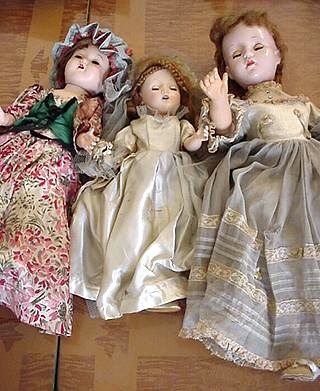
And they can put it with my dolls,
My childhood, and the string of spools
I've finished threading too.

Baptized before without the choice,
But this time consciously, of grace
Unto supremest name,
Called to my full, the crescent dropped,
Existence's whole arc filled up
With one small diadem.

My second rank, too small the first,
Crowned, crowing on my father's breast,
A half unconscious queen;
But this time, adequate, erect,
With will to choose or to reject.
And I choose -- just a throne.


This was the language my own heart - and the heart of the people I saw, seemed to want to speak. Through the many years since, Emily Dickinson is the one who has told me to be brave, to live myself and noone else. I've often ignored that voice. I've often perverted that voice. But, the language itself is still clear and sweet and true.

I put Emily up for my button of 'Wonderful People', because this thing she tells me is what I love in the people I think are wonderful - that they always question the script.

Read More......

12.03.2009

Love Song to Emily and Sylvia

All my loves as a child that would whisper my ears
        with a fountain pen
                Instead of their lips -
                Instead of their tongues
        Their manuscripts.
        Such pretty ghosts!
                I made my oaths
                That when I grew
                I'd spin and spin
                        A reliquary sack to hold
                        Their paper-bones,
                All dry, all dear
                It makes me shiver even now!
                        I would appoint
                        Myself to be a pot of earth
                        Myself anoint
                        To be their parish plot
                I'd take the bones,
                And plant them deep
                like tulip bulbs
                Perhaps to sprout -
        Perhaps to bud - and then
Like necromancy - bloom and seed
        "A Lazarus show" in
        An "unlocked rose"
        For a
"Pretty Red Heart"
        For a
"Wand'ring Repose"

All my childhood loves spoke in gospels
        In very dark rooms,
        Staring into the gloom
                To adjust to the scarcity,
                Dilate the eyes,
                        And bend over the loom,
                Let the Word feed the twine
                Let the Flesh weave doom
                Let the Spirit cut ends
                So my prophets can stand
        And turn back from the tomb,
                In a dazzle of sun,
                They are 'bronzed' like the gods
                        Grown 'quick with the seed'
                        Of forbidden-fruit trees -
                Milk and honey could flow
                From the soles of those feet!
        I was Israel's child, and I begged them
        "Come down from your Nebo!"
        They told me 'Be Joshua!
        Jordan will part!'
        And the sun clave their tongues
        And a flame filled their hearts!
But there's futures
        That cowards can see
        To which sibyls are blind.
So I hid in my house,
        From the flooding divine,
So my "heart" grew "root-pale"
        From a surplus of damp
And an absence of rhyme
                        

All my loves stood on pyres
        Bound to stakes
                With their girdles and corsetting cord
        With their skirts
                That would wave like a standard of war
        With their skirts
                That can't stretch o'er a cavalry horse,
        I longed to stand so -
        Just as still -
        Just as bold -
                I wanted to ossify -
                        Turn to a tree
                        Or a great old stone
                        Something round,
                        Something still and alone -
                How I longed
                        To be someone with fate in her tongue
                So I made up a sorrow
                        And said it was true
                So I put on a silk shirt
                        And new saddle shoes
                        It's the best I could do
                 Just an ill-made farce.
        And a cynical heart
        Made for riding "the rack and the screw."
So I stitched up a bride
        Picked the sticky worm-pearls
        From her Gypsy-Jew eyes
And I said
"I do,
I do"

(originally from 2007, revised several times. Still not happy with it. Numerous esoteric references to Emily Dickinson and Sylvia Plath poems. Picture by eraphernalia_vintage)

Read More......

11.27.2009

Emma Goldman

(After two days off at Thanksgiving. Sorry for lying about my posting schedule!)

Emma Goldman is a famous political activist from the turn of the century in the United States. An Anarchist, feminist, advocate for labor, and champion of immigrants, Ms Goldman was a markedly unpopular woman. At times, I don't necessarily agree with her - she and Alexander Berkman, for instance, conspired together to assassinate a man who ran a factory after it violently suppressed a strike. She famously stated "Ask for work. If they do not give you work, ask for bread. If they do not give you work or bread, take bread." I will even admit I don't know that much about her. A nice introduction to her life can be found here, and I'm planning to read her autobiography sometime, hopefully next year. Overall, I don't always agree with Emma, but from what I know of her, she was fighting the good fight, as best she could.

But, what she thought is almost beside the point - her image isn't up because I'm an anarchist, or anything. It's that when I was young and first saw this picture - it's a very famous one of her, and, being a mugshot, apparently a fairly typical one - it had a feeling of beautiful hominess - I do not know enoguh to judge her actions, but her feelings, in this image, are the feelings that I wish we all had when we looked at social issues: a feeling of deep, compassionate love for all humanity. When I believed in the Church, this is the sort of face I would have imagined Christ making: complex, filled with love and fury, passion and gentle affection, force and kindness. It's the sort of face I wish that I could face the world with. And as a metaphor, the bones of her beginnings always felt powerful to me: while working in a corset factory, she learned about the ways the world crushed people. As an American - a nation that is in many ways ever weaving the world's corset - this means something to me, something that says that we should do, even if we make mistakes, we should do, and try, and make the effort anyway.

Ms Goldman, then, serves as my link to 'Things That are Wrong' - my little round of posts on things that ought to change. Amanda will occaisionally mention how she hates politics, and it always sends me for a moment's loop - because I don't think of Things That are Wrong as politics. The 'politics' is just the forum that we've all made to do what we should do about things that are wrong - or things that could be right. Or even things that could be more right than they already are.

I have a number of topics that are particularly resonant with me: gender and sexuality issues, Haiti, the Romany people, technology ethics, and anti-plutocracy are probably the things you would hear me harp on the most often. I try always to look at these issues with the eyes in that picture, eyes that plead instead of mock, that try to understand instead of try to convince. I know I fail miserably at times, and that I frankly don't think often enough about things that matter more than my petty-day-to-days. But, again, I think I should do, even if I make mistakes, I should do, and try, and make the effort anyway.

Emily Dickinson once said:

If I can stop one heart from breaking,
I shall not live in vain;
If I can ease one life the aching,
Or cool one pain,
Or help one fainting robin
Unto his nest again,
I shall not live in vain.
I've broken hearts but do not know how to mend. I've burned but do not know how to cool. I've knocked the robin's from their nests, but don't have the stature to reach up and gently put them back. But maybe, in my little way, I can speak so that some taller, cooler, better mender can know these things still wait to be done.

Read More......

10.24.2009

Tribute to an Invisible Thing

I never met Dewey - I simply don't have a long enough pedigree, I'm afraid, to have been here long enough. Amanda, I know, had read her blog a few times, but was again too late in the game to really know her that well. So, I don't really even know her second hand. I only knew her thirdhand. Sometimes 4th, or 5th, or 6th hand. Which means that you any tribute I offer is going to be kind of obtuse. Since I know and love so many people who DID know and love her, I apologize if the tribute comes off that way. In fact, I will admit that (like most of the other mini-challenges), my general timidity and laziness (and to defend myself a bit, the fact that I've been engrossed in some very delicious books) had suggested to me that perhaps I should just skip this challenge. In the grand scheme of things, I'll feel kind of blushingly silly anyway, if I win a prize for writing a tribute to someone I never had the opportunity to meet. And that last opinion does still stand - I am TOTALLY not accepting the prize if my name comes out of the hat. But. Nonetheless, despite the fact that my readership is so tiny as to make a tribute insignificant, despite the fact that the word 'tribute' makes me longwinded, thus negating the possiblity that most people will have time to read it on a day like readathon, and despite, agian, my terrible ignorance on the subject, I have this little nagging desire to write something up about Ms Dewey. I never met her. I've met a number of other, I guess, pillars and old priests and priestesses of the book blogging community, who knew her, who talk about her, who love her (present tense, yes). But I never met her. As a book blogger, even in the strangest smallest little way that I can call myself one, this has a strange feeling, it is something like growing up and suddenly getting sufficiently old to realize that your mother is dead, that you never knew her. There is a hole in your family, a hole that the ones you love feel keenly and openly and honestly. And yet... it's a whole that you don't know how to trace, a hole that you cannot even imagine the feeling of filledness about, a hole that you feel desperately as if you'd like to love, but that when you move to go and kiss the cheek there, there is no cheek, no face, no warm mother arms, just a chair, a chair that is empty, that has always been empty, that in your small, child's sense, will always be empty. There is a hollowness, and still a raw one there, a hollowness that's very inscrutability speaks to the depth of the one who filled it before it was empty, and a sense of very bashful loss to that, a loss you cannot really put into words - and that, really, you'd feel silly trying, since you know you cannot ever FEEL that loss with the reality of the ones who were there, the ones who saw the chair before it was a raw and empty wound. Perhaps... perhaps I make something more of it than it is. Chairs, like the place of mothers in families, will be filled, in some sense, I suppose. New matriarchs find their footing, families learn to walk around the craters left behind. But still, there is the feeling, the strange and glassy sort of sadness, of finding momentos of things you cannot remember, locks of hair from a head you've never seen, rings and gloves from a hand you've never held. It is not a thing to think much of for yourself, but it is the only small way, that little people, like me, can understand the little deweyness of the eyes (and ironically, I didn't originally intend that as a play on words... ) of the people that we DO know and love, the people that we DO look up to, who do come and tend us when we scratch our knees. IT is the sort of hole that becomes a poem, in one way or another, that becomes one stitch in Ms Debi's crocheted pumpkins, or one ribbon in Ms Nymeth's Bookmarks, one little word of Ms Eva's careful, crystal prose, and maybe, just a tiny bit, the tiniest echo of a far off syllable ringing even down through a little blog like this. Ms Dewey, though I never met you, I'm happy to have the privilege of missing you, even in my little way.

Read More......

5.29.2009

The Emily Dickinson Kindle Portrait

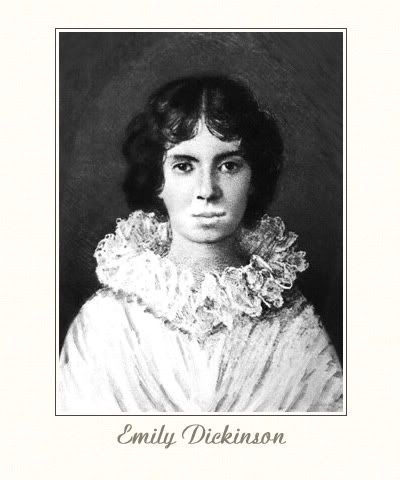
Most people who read this blog probably know I'm a big Emily Dickinson devotee, so I won't wax sentimental. However, a matter has come to my attention, a matter of serious import, and since Ms Dickinson is dead, it behooves me to defend her honour. I am talking, of course about the picture of Emily Dickinson that pops up on the Amazon Kindle screensaver, which is giving poor Madame Dickinson a bad name. The thing is, look at that picture, it's creepy. It's not a nice picture. It looks like Emily Dickinson had a love child with a lace doily. Ick, right? Well, let's look at it for a minute, in better detail: Those of you out there who've ever used photoshop will, doubtless, begin knitting your brow now, but let's take a quick look together, shall we? Witness those eyes, isn't that strange how her left eye and right eye are different shapes? And what's with the big smudgy white place around her lips? Then, look at the shadow. There must be some strong light on there, so how come her nose is shadowing downd and to the left and her lips are shadowing straight left? Hrm... it must be DOCTORED! Yes, indeed it is doctored. The Harvard archives, in fact (where much of the Dickinson errata of the world is stored) hold records saying as much. In fact, they have the photo in it's stages, as it went through the doctoring process. Witness:
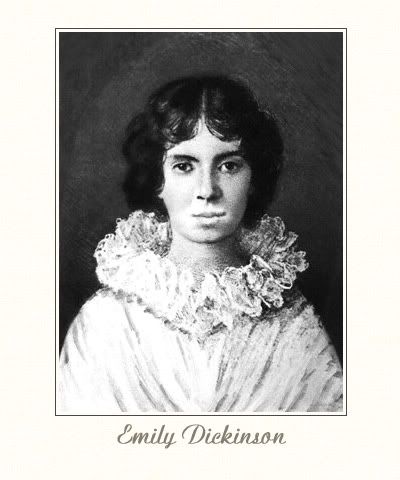
* (1) Dickinson, Emily, 1830-1886. Portrait, 1978. 1 item: photograph. Caption on recto: "Photograph of the unretouched and unframed daguerreotype [ca. 1847] of E.D. owned by the Amherst College Library. Presented by Amherst College Library [March 31,] 1978. Permissions sh[oul]d be granted only by Amherst College Library." This item is for reference use only, not to be reproduced. *99M-3. * (2) Dickinson, Emily, 1830-1886. Portrait, undated. 2 items: 1 photograph and 1 negative. Photograph annotated on verso: "Emily Dickinson of Amherst when about 17 years old taken from a daguerreotype which her sister Cousin Lavinia Dickinson gave me to have copied, Gertrude M. Graves. Sep 23. I am sending today another copy of this to her niece Mme. Bianchi. G.M Graves." Image is possibly slightly altered from image in item (1). *46M-287. * (3) Dickinson, Emily, 1830-1886. Portrait [with altered hairline], undated. 4 items: 3 photographs and 1 negative. This image is an altered version of the ED daguerreotype. Labeled "first stage" by L.B. Graves. *46M-288. * (4) Dickinson, Emily, 1830-1886. Portrait [with fluffy hairstyle and white scarf-type collar], undated. 2 items: 1 photograph and 1 negative. This image is a further altered version of the ED daguerreotype. Labeled "intermediate stage" by L.B. Graves. *46M-286. * (5) Dickinson, Emily, 1830-1886. Portrait [with fluffy hairstyle, stand-up ruffled collar, and white bodice], undated. 3 items: 3 photographs (2 framed). This image is the final altered version of the ED daguerreotype. Item 2 is framed in black and has label on verso: "No. A11382 Doll & Richards. 2 Park Street, Boston." Item 3 is framed in brown and has label on verso: "No. 8276 Bigelow & Jordan ... Boston, Mass." Label includes Ms. annotatations: "Picture of Emily Dickinson owned by Gertrude M. Graves [illegible] Boston, Mass." Labeled "final state" by L.B. Graves. *46M-289.
So, that is the original daguerrotype? Let's put them side by side: Now look close, can you see it? The image was reversed, the hair was pasted on (look close, you can see the shadow of her original hairline, in fact), and they put on the frou-frou. Then they drew a buttload of makeup on her, dolled out her eyes to anime width, and attempted to make the shadows more dramatic, thereby gifting her with a shadow of a moustache (in all fairness, doesn't this picture look more like Frieda Kahlo? Only without the authenticity made Frieda beautiful) In truth, just so we can clear this up now, there are four ACTUAL images known to exist of Ms D. Lets lay them out, real fast: The childhood portrait: The silhouette: The teen picture: The recently discovered older picture: (in the interest of full disclosure, there is some scholarly debate about whether this is really Emily D) Then, special notice of the lock of hair, which is KIND of like a picture: Amazon, all these images are lovely, the Dag and the silhouette are fairly iconic and recognizable - why did you have to pick the one picture that's a blatant fake? I do not know, I will not profess to know, and I don't mean to imply that Amazon made these alterations - this horrible picture has been 'round since, I believe, the 70's. I would admit it's possible that Amazon didn't even realize it was a fake. But I will tell you why the image frustrates me so much - obviously (while they, in my eyes, failed) the picture that you see on your Kindle is meant to doll up Emily Dickinson, to make her pretty. And I'm left with a sick feeling, like we all need to have a pretty poetess if we're to love her. Is the image of Dickinson that's genuine somewhat unsettling, unconventional, even, I suppose, conventionally somewhat unattractive, in many people's minds? Sure. Who cares? Lord, have you seen Charles Dickens lately? Yeah, imagine kissing THAT every morning. But who cares? We don't worship Dickens because he was a hottie. He was a great author. And having read Dickens, I like his face now. It's got this slightly dopey, but deeply, stridently genuine face, that LOOKS like Dickens. He looks exactly like himself. And Emily Dickinson's poetry? It doesn't look like Ms. Frou-Frou-Curly-Mop. Emily Dickinson was not delicate and pretty and tra-la-la flowers. There's a part of our culture, though - and I struggle with it too - that still... well, it NEEDS her to be frou-frou. Frou-frou we can handle, frou-frou is acceptable, we can process it. Strange and striking, that's for boys, right? Keep on fighting Frieda Kahlo, Emily Dickinson, Emma Goldman, all you odd, beautiful souls, aware of and happy in your peculiarities, battle ain't over yet, 'pparently.

Read More......