Showing posts with label james Joyce. Show all posts

3.20.2011

Familiarity and Contempt (What Was She Thinking? by Zoe Heller)

Good god, I forgot what it's like to read a book where each page takes less than 15 minutes! It feels strange to be in the realm of books one can read as an activity instead of a journey. Not that I mean I regret Ulysses - just sometimes it's nice to simply take a day-trip to the park, rather than hiking the entire Appalachian Trail.

If you haven't read What Was She Thinking (also called Notes on a Scandal, after the title of the movie it inspired), or seen the movie, there will be spoilers in these thoughts, because I'm really not sure where to end before ruining any surprises.  So, now then, only us spoiled or spoilable folks left? Alright, then...

The very first page of the book presents for us what appears to be an easily parsed framework for interpreting Sheba, the nominal heroine of the book: she is a woman who has had an illicit affair with a 15 year old boy. She has been caught. It's a nasty business. The news has introduced this particular character type, in the real world more than once (seemingly every time it happens), and in the beginning, there is a natural tendency, I think to assume that any further story will be simply the salacious details. The narrator, Barbara (in many senses, I think, the true protagonist of the novel), is much more of a mystery - she's older. She's loyal to this woman who has done something impardonable. She is a bit cold and bitter.

By the end of the book, Barbara has done her very best to show us that Sheba is a faulty, essentially non-evil woman who committed a horrible mistake. One can (if one wishes) pity her, sympathize with her. On the other hand, unwittingly, Barbara reveals herself to be, as most people I know describe her, very creepy. Sheba let her hormones overtake her. Barbara seems to have something very distrubing wrong with her.

The interesting thing to me is this: Barbara, I think, one knows fairly well by the end of the book, and one despises her. Sheba, who one is given the opportunity to pity, one knows in many ways LESS than they did on the first page of the book. The narrator is clearly not terrifically reliable, and obviously sees Sheba in a way that suits the fantasies she needs to uphold for herself - how are we to trust that anything she says really accurately reflects on Sheba's character? Take, for a moment, the mere facts apart from the very artfully applied layers of interpretation, and one has learned very little by the end of the book, really - some details of Sheba's family life. A rough timeline of how the affair went. A highly coloured personal account of some of the day to days of the end of the affair. A frankly unreliable account of second hand knowledge that we don't know if it's even accurate. The image of Barbara, is, inadvertently, more or less an honest one. The image of Sheba is a more or less dishonest, or at least dubious, one. And it's much easier to like Sheba than Barbara.

This particularly caught my eye because the way Barbara details her life reminded me in some ways of Ulysses (sorry, I know). Barbara, perhaps because she lives alone and has no particular center or direction to her life outside of Sheba, is left, in between the periods in which she is merely reinterpreting Sheba's life, describing her life in very exacting detail. By the end, one knows how Barbara gets dressed, how she feeds the cat, the manner of cook she is, the way she keeps her bedroom and living room, her personal grooming habits, the way she sleeps even. Bloom's journey through Dublin is told in the same exacting detail (we were not, perhaps, left with a description of how Ms Barbara goes to the bathroom - but she did comment on the menstrual habits of her coworkers, so I think this was more an issue of space and first person narration than any sort of actual fastidiousness). And I've heard more than one person who read Ulysses mention how surprised they were at how much they disliked Bloom, and in much the same way that one dislikes Barbara - he's a little off, a little bit disturbing. Revolting.

In many novels one gains a certain intimacy with the characters, and understand please that the comments Im about to offer are not belittling that. But most of that intimacy is only with their inner selves - in some sense I think this is what we turn to literature for, to look at someone and be able to see something more 'real' than the everyday. Joyce turned this around and presented the everyday as the framework of the epic, and so I think that it's easy to look at his characters and think 'how disgusting', because one must see all the detritus of their daily thought patterns. I daresay that many of our hero's thought patterns would be equally ugly if we took them in unexpurgated. In part, I think this is the problem with living in Barbara's everyday world - familiarity, as they say, breeds contempt (or horror, or disgust).

I am not everyone I know, I'm only me, but I will say that a tepid toe dipped deep in the stream of my consciousness would be equally loathsome. I say this as impassively as I can. I think any number of ugly, unpleasant things, I'm plagued by a discordant, disturbing mishmash of non-cohesive patterns of internal life, most of them worn deep enoguh that the groove has gone smooth with time. This isn't, I don't think, because I'm deeply secretive - I try to fairly honest and forthcoming (not that I always have in my life). It's simply that writing about one's self naturally condenses identity into something cohesive. Maybe this is a sort of innate dishonesty, for my own benefit - I need to believe there is a self to build an identity around, instead of a raucous blend of things, most of which should be ignored or suppressed in order to function in the world. I don't know, I wonder sometimes if the feeling is more universal, if perhaps many or most of us have internal selves that stoke at a fire of contradictions.

There are two points to this. In some ways, it is a simple one: simply that knowing a person might tell us things about them we might not be glad we learned, and that we should, thus, take our knowing with a grain of salt - not becaus what we know is necessarily untrue, but because it is confusing to know a person intimately that way. The everyday has a way of bringing up the tics and highlighting them, leaving us blind, ironically, to the virtues of a person - which ironically intensifies the tics in our subject themselves, and declines the influence of virtue. Theory of PErsonality Relativity, I guess.

The other point, though, is I think it's interesting that the repulsive Barbara is, in fact, a writer herself - her manner of writingis not simply narrative, it's 'writerly' - complex, beautiful, very funny at times, poignant at others. She is not a diarist, but a novelist. And what's interesting about that to me is that she is making a novel of Sheba. The difference between the book and a real novel is simply that the ACTUAL author works so hard to see the machinations of the false author in producing the false account of the protagonist - we see, in essence, the making up of a hero from scratch, from the eyes of the novelist, without her explicit awareness of the revelation. Which makes one turn back for a moment to all the heroes in all the other novels they've seen created. Jane Eyre, for instance - it's difficult in a moment of clarity not to see how much Bronte needed her to be a hero. Or Stephen Dedalus. Or any of a thousand others. Authors write heroes, as often as not, because they need the validation of seeing someone else worship their illusions.

I don't mean this as a dig against literature - clearly I'm not opposed to Jane Eyre or Ulysses. I think that in truth of truths, though, there is no 'true portrait' of anyone. To make others feel for a character, one must describe the character artfully, art implies passion, and passion, by definition, precludes dispassionate honesty. I'm not sure it's even really a 'warning' per se. In some sense, I will admit, I believe that this lack of clarity is wonderful, because when you really look at a person, you're not looking for a catalog of their attributes - a catalog of attributes, after all, is the whole problem with knowing someone to intimately. You're looking for a story, for someone to connect little cohesive webs that let you wrap your mind around a person. Those webs can't be complete images of a person, of course - a person is made of the paints the web stretches between, not of the threads that you actually see. But something like the way an artist will use a color that is absent in nature to produce an illusion that's realistic, this sort of skewed portrayal can be far more 'honest', in some senses, than a clinical description

Read More......

2.15.2011

Human Dignity in Joyce's Ulysses

More than one description of Joyce - and particularly the one I'm reading by Declan Kiberd - focus on Ulysses as a glorification of the human spirit, a sort of paean to real people in parallel to the paeans to idealized men that were to be found in books like, well, The Odyssey. (One could have some strong words of difference about whether Odysseus is an idealized man, of course. Perhaps that's the point). Stephen is a normal man attempting to be an idealized man, and in many way, Bloom is simply a normal man trying to be what he is.

This sort of story is a difficult one to grapple on to, of course. IT is, in many ways, the biggest sacrilege in the book - our culture, through a thousand ways, builds itself around the idea that all of us should be struggling to move up from our current position. This is the definition of the American dream, and while slightly different historically, was certainly at least the stuff of fairy tales. Great souls rise above their circumstances, the words say, and become great through sheer force of will. I don't necessarily disagree with this, I do sometimes wonder at the teaching that is inextricably attached as a verso - that those who do not struggle towards our, frankly narrow, definition greatness have failed, wasted their lives. Normalcy is mediocrity - or in an odd,  twist of fate, even sub-normalcy. People who are not 'smart' are 'stupid'. People who are not 'driven' are 'lazy'.

I don't think this is the disease, per se, I think, rather, that it is a symptom. I don't know that Bloom (or necessarily even Joyce?) would agree, but reading sections four through six, where Bloom is introduced, the power he has in my eyes is that he is never struggling for primacy. The person who need not struggle for greatness is a pretty common trope, but usually this is on, say, the Mr. Miyagi vein of heroism : one has attained such mastery that struggle is no longer necessary (I will interject here as a side note that I remain dubious that this state exists in real life). Bloom, on the other hand, simply seems apart from greatness - he sees people struggling for it, just as he sees, say religion, but in both cases, he simply watches from afar. I find this, in my own brain, inconceivable, but I so WISH I didn't.

In a sense, though, this is also the troubling aspect of Joyce - Bloom is, decidedly, not great. He is not an ideal (I think Kiberd sometimes wishes to make him one, but I think Joyce is fairly realistic about his heroes limitations). This is both the horrifying and fascinating side of Joyce. Modern stories I have read frequently have these nasty, grey-moraled heroes, but one is supposed to either bitterly accept that this is the best we can get, or roll our eyes at the awful people that sit behind the masks we worship, or simply to laugh at the vanity of human pursuit of greatness. With Joyce, there is no irony, really, in his Bloom. Bloom is, simply, who he is. And so when Joyce makes him the hero of the novel, and plots his life as a parallel of the Odyssey, it's not to mock the Odyssey, and it's not to mock Bloom. Bloom is the bona fide hero. Which puts me, as a reader in an uncomfortable position. I want to, at some level, force Bloom to start 'acting heroic', I want to have a reason to admire him. And then, I'm reminded, this is the HARD work, this is the work of actually looking to discover what basic human dignity is. It's very easy to find dignity in the classic hero (though sometimes easy to find flaws as well). I would argue that it is often even fairly easy to find dignity in the extremes that are held up as the laboratories of dignity: poverty has a rich, powerful dignity much like heroism, even crime can have dignity. Homeless people in dire suffering or starving masses in third world countries, we have learned as a society, by and large, to look for dignity here (though not necessarily to do anyhting about it, sadly, or to go looking for it).  But normal, bourgeois humanity, the lifeblood of most of our day to day interactions, we have been taught is low, callous, cultureless, personalityless. A middle class advertising man in early 19th century Dublin had the same totemic soullessness in some ways that a suburban soccer mom has in a hip, trendy book today. And we ARE in love with talking about the soullessness of 'normal' people - American Beauty, the middle section of The Hours, Pleasantville, even kid's movies like Over the Hedge make no bones about making this broad generalization, for instance.

But, that's just it - this is the sort of person Bloom is, on the outside (and in some ways, inside) level - a completely unromantic hero, undistinguished, unspecial, unimportant. If he were alive today, he'd work a vaguely roled job in HR or Marketing, maybe lower middle management in some soulless corporation (see how easy it is to say that?) and live in a little McHouse in the burbs of a mid-sized city, sometimes going in to see a show, but mostly just (somewhat awkwardly) talking to his fellows about the latest action flick, ogling girls at the office, and driving his SUV home at the end of the day. But, none of this makes him less human (even though I do love movies like the middle section of the Hours, and think there's a lesson there, too). None of this makes him less deserving of human dignity - and he does not have to break that mold to merit dignity. The protagonist in 'Fight Club' is a human being, and deserves our respect as such -- but so did his boss, or the spineless coworkers he left behind (Fight Club, in some ways (and I think in some ways purposefully) actually has a great deal to say about this demonization of the mundane).

And this is what's troubling. This is what, at some level, is the deeper part of the complaints about having to read a scene where he's sitting down for his morning poop, or worrying about the soap that he left in his hip pocket that's jabbing into him, while simultaneously not wanting to be seen moving it. Yes, these things are ridiculous. They're also part of what being human is. But it's harder than one would expect to keep that in mind while reading. At least for me - hey, I was raised on Victor Hugo, remember?

Read More......

12.16.2009

Finnegan's Wake by James Joyce

Reviewing Finnegan's Wake is an impossible thing. Well, that's going too far, I could review it. I could even write a somewhat funny review. But I could not write a review that would actually be useful. The only information in a review that would be useful would be more easily picked up in a Wikipedia article. The rest of the review would be about me, not about Finnegan's Wake.

So, I am not going to review Finnegan's Wake. I am not going to give it a star rating, I'm not going to tell you that I loved it or hated it, or suggest whether or not you should read it. Instead, let me tell you what I felt, reading this very strange book, because Finnegan's Wake, in a way that no other I've read can approximate, is an experience far more than it is a book.

On Tuesday, I was reading the book as I walked across the breezeway at work (this isn't uncommon for me. I also type while walking. Yes, I know, I'm a geek). It's pretty common for someone to comment on this. Usually, this leads them to asking what I'm reading.

The woman who asked me was a small woman, with a very, very quiet voice, with red, greying hair, and birdish nose and eyes. I'd done a ticket for her once before. She smiled and told me it was nice to see someone reading, and asked what it was. I showed her the spine, and she was very excited.

This was a unique reaction. I've been reading Finnegan for about four months, and it's not the first time someone has noticed it. Most people don't know what it is. But, I work for a publisher, there are many who do. Most who do out and out laugh at me. Some of them ask me why I'd ever read it. Once in a while someone tries to impress me with their knowledge of Joyce. Sometimes someone purports their superiority over the book. I make this sound bad, it really isn't. People find the idea of the book either ridiculous or threatening. I can sympathize: I have in many parts of the book found it to be ridiculous or threatening.

The tiny Irishwoman who I was speaking to now did neither. Instead, in an animated whispery voice, she started to tell me all about James Joyce, about what happens to her when she reads, about the ways it feels like home, and life, and people she knew. The details are interesting, but not really pertinent, here. It was the feeling that mattered to me, a feeling as if I could, indeed, mean what I was doing.

I guess it sounds silly, but the experience of reading Finnegan is actually a really threatening one, and not because of the book. Finnegan's Wake is sort of the Abortion Issue of books. Some people feel like it is deeply important, others like it is an abomination, written to destroy literary culture. Others simply think it's trash. The problem is, none one of these camps is a comfortable one to interact with while actually reading the book. The camp who considers it trash is fine, and the best of the three, they're simply somewhat uninterested. The camp that thinks it an abomination is obviously uncomfortable. It is the third camp that surprised me. I'm not a huge scholar, I never really interacted with academia, and I do not know how common this is generally, but in terms of people talking about Finnegan's Wake, there is this terrible, unwelcoming, and very, very lonely feeling of self importance. It's hard to put a finger on, and I don't think it's always conscious. But talking about Finnegan's Wake seems to always end up being a conversation about the cleverness one exhibits in knowing and being able to talk intelligently about Finnegan's Wake. Which, when one has not read Finnegan's Wake, and feels patently unclever about what one has read, is discouraging and unhelpful.

The book I picked up in conjunction with this has been helpful in this effort: Joseph Campbell, of Hero of 1000 Faces fame, wrote I think the first comprehensive guide to Finnegan's Wake in 1944. The book is now, apparently, pretty outdated, many of his suppositions being 'disproved', some of his scholarship incomplete, etc. I'm sure all this is true, honestly. But it didn't matter, because Joseph Campbell really, really seems to love Finnegan's Wake: Finnegan's Wake, after all, is the book that invented the term 'monomyth'. And, reading Joseph Campbell's retelling of the book (because that is more or less what it ends up being) was a beautiful experience, sort of a slightly disconnected experience of watching someone see themselves in someone else's piece of paper. I did not read the same story Campbell did, when I read Finnegan's Wake. But, then, I don't think that's because his story isn't there.

That's the strange thing about Finnegan's Wake. It's an alive sort of book, as stupid as that sounds. It's very vagueness seems to wrap itself around whatever guideposts are already inside your brain. When it was Guy Fawkes Day, and I was learning about the background I ended up reading this line:

...ony twenny minnies moe, Bully his Ballade Imaginaire which was to be dubbed Wine, Woman and Waterclocks, or How a Guy Finks and Fawkes When He Is Going Batty...


When I was thinking of my poem about Emily Dickinson and Sylvia Plath, I read my line about trying to infuse poetry into my own bones:

I'd take the bones,
And plant them deep
like tulip bulbs
Perhaps to sprout -
Perhaps to bud - and then
Like necromancy - bloom and seed
"A Lazarus show" in
An "unlocked rose"


Then, read this line from Finnegan:

...appropriately, this Esuan Menschavik and the first till last alshemist wrote over every square inch of the only foolscap available, his own body...


Frustrated with my children one day, I read:

The pleasures of love lasts but a fleeting but the pledges of life outlusts a lieftime.


And realized I sounded as ugly as the speaker in my grouching. I would find references, it felt like, to computer coding, to current events, to the feeling of being in an old, broken down Chevrolet, a thousand tiny things that are impossible for Joyce to have considered while writing the book, but were strikingly, presently real. Because, that's the thing about the text. It leads you along for pages and pages of things you don't understand, and then there will be one line, one image, one little snatch that seems stupid when you quote it (as above, sorry!) but feels absolutely, irrevocably real in the moment.

And after hundreds of hundreds of pages of slow, steady confrontation with your own ignorance, and then these short bursts of unnatural light, illuminating sometimes very unattractive corners of your own psyche, you become very, very exhausted. The book, unwillingly, became a sort of piece of me, a "dream of favours, a favourable dream. They know how they believe that they believe that they know. Wherefore they wail."

And so I hated the book, in a very odd way, a way I hadn't hated any other book, in a sort of possessive, preserving kind of hate, the sort of hate that feels more like self-loathing.

So, when I could have someone speak to me about it, and feel a bubbling sort of vision, a reflection of bright eyes that had already been down the pages of the book, it was liberating and comforting in a strange, powerful way:

Ah dew! Ah dew! It was so duusk that the tears of night began to fall, first by ones and twos, then by threes and fours, at last by fives and sixes of sevens, for the tired ones were wecking, as we weep no with them. O! O! O! Par la Pluie!


Perhaps that's why the end of the book touched me so deeply. In the end, the main female protagonist (such as there is one) who is also a river, is flowing out to the sea, even as another she is being reborn from the river springs, in the eternal unending life-death of a river. She thinks back on when she was what she somewhere faroff in the mountains is at that very moment: a pure, lonely little rivulet running by at a quick, pretty pace. And even as she thinks of that, she, now the dirty, mother, all loving all accepting end of the river, oozes muddily out to sea. And when I felt that river, the river that I know wraps all through the book but which I so seldom could even consciously sense was there, losing itself in the great ocean, I almost cried, today, sitting at my little desk doing nothing important that will ever, ever matter at a little job in an enormous company I don't believe in. Suddenly, I realized that outside of all the hatred, boredom, confusion, disgust, and everything else, there was a little something alive in this book, and perhaps in myself, that I loved:

I'll wait. And I'll wait. And then if all goes. What will be is. Is is... Sometime then, somewhere there, I wrote me hopes and buried the page when I heard they voice... in peace and silence. I could have stayed up there for always only. It's something fails us. First we feel. Then we fall. And let her rain now if she likes. Gently or strongly as she likes. Anyway let her rain for my time is come... They'll never see. Nor know. Nor miss me. And it's old and old it's sad and old it's sad and weary I go back to you, my cold father, my cold mad father, my cold mad feary father, till the near sight of the mere size of him, the moyles and moyles of it... make me seasily saltsick and I rush, my only, into your arms.
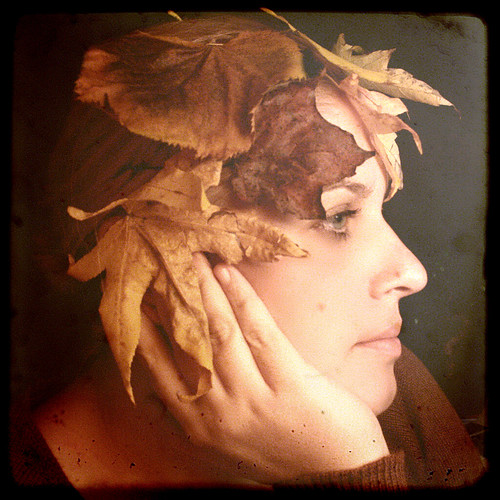
(Image from Mlle Mathilde, inspired by the lines just after the last quote: "Avelaval. My leaves have drifted from me.All. But one clings still. I'll bear it on me. To remind me of.")

Read More......