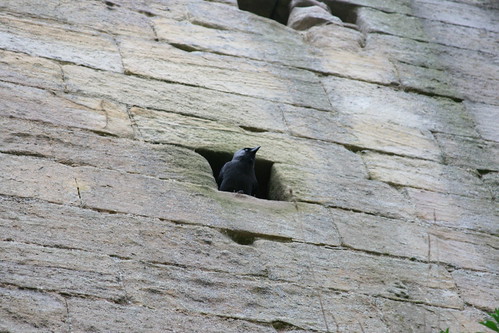
Once there was a wicked man, who lived far too long, and on his belt was a leather sack, and in the sack were seven glass eyes. And each day he would open his sack, and the eyes would turn and look at him, until one day, they would not look away, and he could no longer live in the city of men. So he left, and went into the empty lands.
And on his belt he had another leather sack, and in this sack were seven berries, bitter-black and dry, with the seeds rattling in the heart of them. But the empty lands were so empty! So he took from the sack the seven berries, bitter-black and dry, and buried them in little mounds, and waited for the rain. The rain took a long time in coming, but he waited, for he had already lived far too long, and he had time. And then the rain came, and the little berries sprouted thickets, bitter-black and thick with thorns.
Then the man went round to the seven bitter-black hedges, and opened up his other sack, and in the nook just above the roots, he nestled, in each hedge a single glass eye. And then he trimmed the low branches, so that the hedge grew high and broad into seven trees, and the gnarled thorns wrapped round themselves into a trunk, and in the wrapping, wrapped around the eyes, and closed them in tight. And the growing took a long time in coming, but he waited, for he had already lived far too long, and he had time.
And then he waited, for the trees to bear their fruits, for the winter was coming on, and the flowers were fallen, and the buds displaced. And the fruit too was slow in coming, but it came, too, rich black-violet, and heady with its own smooth bitterness. And the birds came down and gnawed their beaks against the bitter-black skins, until each thousand-fruit split broad, and in the center of each fruit was a pink and mournful tongue. And all the tongues cried out against the man.
And though the growing had been slow, the song was quick, and the hearing quicker, and a great storm came down, and it tore and fought, and heaved and wept, and buckled and drank, and vomited all that it drank down. And when the storm was gone, the man came out from under a brake of ferns, and six trees lay before him, snapped off at the trunks, just above the ground. And in the jagged stumps, laid clean and clear and watchful, there were six glass eyes. And the man rejoiced and took the eyes, and put them in his leather sack. And the tree that still remained stood quiet in the empty-lands, and said nothing.
But God came down then, and sat by the man and watched him as he tied the sack up tight. And he watched as the man went to the lone remaining tree, and from it plucked seven berries, closed up and shriveled, dry and rattling, and he put them in the other sack. And then, the wicked man, turned and he looked at God, and God was what he always had been - not God, but just the God of the Bitter-Black Wood. And the wicked man reached out his hand, and the God of the Bitter-Black Wood plucked out his glass eye, and set it in the open palm of the wicked man. And the wicked man put the eye in the little leather sack, and turned to walk back toward the city of men.
Read More......
One doesn't have to know me terribly well, to know I have a soft spot for fairies. I could write about why another time, but sufficeth to say, I have one. If you've been reading a long time, and REALLY been paying attention, you may also remember that my book arch nemesis, the book that I've never been able to conquer is Edmund Spenser's 'The Faerie Queene'. Well, all this converged at the beginning of this month when I was thinking of what I could do in terms of reading this year. For the last few years, I've picked an author and read at least a broad swath of their most famous works, to really get to know them, as I did with James Joyce a few years ago. So this year I decided to try something a little different - instead of reading one author's many books, I'm going to work my way up to reading the Faerie Queene, later this year.
So, this coincided nicely with Ms Allie at A Literary Odyssey, who decided this month to have a Shakespeare Reading Month. Spenser and Shakespeare were near contemporaries, and both of them have some rather famous forays into fairyland. More importantly, the writers of Shakespeare and Spenser's time, in many ways, began to invent the idea of fairies that we have today. The Elizabethan fairy is both familiar and foreign to our modern idea of fairy-folk.
This is not to say, of course, that Shakespeare and his contemporaries just cut the idea of the Fairy from whole cloth. It seems, in fact, to be a feature of the human drive to mythologize something that is classifiable as a fairy, and we see incarnations of the 'Wee Folk' throughout the folk traditions of many world cultures. In Shakespeare's day, in fact, this line was far hazier than it is now, when we think of a fairy as a very specific type of being (with wings and sparkles and flower petal clothing - its alright, we can all confess together, its true, that's what we all think of, right?). In Shakespeare's most famous exploration of the fey world, "Midsummer's Night Dream", this is actually fairly apparent, fairly quickly - while we often forget this, now, the setting for MND is Athens, the lord of the city is the Greek mythological hero Theseus, and his lady is Hippolyta, the Queen of the Amazons. The setting and characters, then, hearken back fairly strongly to a classical tradition. Mab and Oberon, even, are character-wise really not a far leap from the Greek Gods, if one thinks about it, and the role of Puck as the messenger of the King is a fairly close parallel to Hermes/Mercury. At the same time, the action takes place in a wood, the sort of wild place that the Greeks would have populated with Nymphs and Dryads.
This sylvan divine aspect of the fairies is repeated again in the other of Shakespeare's plays that grapples, though very differently, with the faeries: The Merry Wives of Windsor. MWW is set in England, so the strong classical allusions of the MND fairies is lacking, here, but there is still a strong thread of connection to lost and ancient gods, as the wives trick Falstaff into dressing as a stag and going into the forest, to meet them - then proceed to dress some of the people of the town as fairies to come and torment him. The Horned Man, or the Horned God, is an old remnant of the pre-Christian past of Western Europe (one that lives on today in many varieties, for instance, of neo-pagan faiths). The connection with fairies, here points to their position as fallen Gods of a sort. There's further evidence of this in the name of Queen Mab, in the (in)famous 'Queen Mab' speech that Mercutio offers up in Romeo and Juliet. Mab is probably derived from the Celtic Medb, or as its often transliterated, Maeve, the name of one of the great queens of the Tuatha de Danaan, the 'Gods and Fighting Men' of the Irish/Celtic mythological cycle.
The fairies, then, in England were not terrifically different from Gods - albeit fallen ones, now subservient to the power of Christianity. Many of the fairy stories we have, with a bit tweaking, ore almost indistinguishable from the mythological tales of the Gods of the Celts, the Scandinavians, or the Greeks, with many of the same tropes: descent into the underworld, rewards for virtue and punishment for vice, seduction of mortals by the immortals, rites of appeasement and sacrifice, etc.
But the question, of course, comes up - we DON'T think of the fairies now as being like Gods, really, whatsoever, short of a somewhat shaky connection to immortality, and a certain degree of magical power. Fairies, in most of our modern ideas, do not live lives bigger than human lives, but rather paradoxically, smaller - literally as well as figuratively. The Elizabethan Age is when you begin to see this shift, from fairies as simply strange, unknowable semi-divines, to fairies as amusing, petty imitation of human life. One of Shakespeare's contemporaries, Michael Drayton, wrote a narrative poem on this subject, entitled 'Nimphidia' (another interesting parallel to Greek myth), the outlines of which could live quite comfortably in the pages of Peter Pan, The Water Babies, or a Tinkerbell cartoon. In Nimphidia, the fairies are so small that ride in spacious coaches made of snail shells, pulled by gnats or flies:
The seat the soft wool of the bee, The cover, gallantly to see, The wing of a pied butterflee ; I trow 't was simple trimming.
The wheels composed of crickets' bones, And daintily made for the nonce, For fear of rattling on the stones With thistle-down they shod it;
This image is not one of the strange old tales of fairies that can strike terror into the country man's heart - this is pure Disney. Much of the writing I've read on this subject seem to treat this decline of fairies from Gods to be worshipped to doll-like children's characters, feel uncomfortable with the shift - its often depicted as a debasement, where Christianity is the bad guy, and the fey are a noble old religion being shoehorned into irrelevance to make way for the One True God, or begin used as a tool to browbeat people into submission to new social mores.
The interesting thing to me, though, is that, clearly given the longevity of the itsy-bitsy fairy, the feeling of these new Elizabethan fairies is a powerful and resonant one to the popular imagination. MND is (rightly, I think) frequently listed as one of Shakespeare's greatest works, and carries inside of its playful whimsy a great deal of emotional maturity, something we perhaps don't necessarily associate with the 'kids stuff' of the adorable little fairy. What were these fairies DOING for the Elizabethan, that made them so attractive?
Well, aside from the need for cute (go ahead, TRY to tell me this isn't a big part of the human psyche - you know you have another browser tab open with adorable LOLCats in it), the Elizabethan Fairy was a remarkably flexible tool for storytelling and dialogue. Take, the fairy story inside of Midsummer's Night Dream for a moment, for example, and pretend it isn't about fairies: Its a story of a court in which the King and Queen are as human, jealous, persnickety and difficult as everyone else, where the Queen ends up making out with a Donkey, and where the King ends up looking perhaps a bit incompetent in his hiring processes. The revelation for me in understanding this was to realize that this story was written in the height of the English Renaissance, at the beginning of the century filled with the birth of the modern mind: Don Quixote, Paradise Lost, The Anatomy of Melancholy - these are books of the 17th century. It was an age in which people began to take a cynical eye to their oldest and most sacred institutions. But its also a century in which people were murdered by the state for being Catholic, Protestant, Puritan, Anglican, Huguenot, etc, in turn. Its a century that would produce the secret police of King Louis XIV or Oliver Cromwell. The production of MND occurred in a time when people began to try to say what they thought, and the powers that be were still structured to silence them. Fairies are, comparatively, safe ways to talk and think about the larger world. Its interesting in fact to think that this same Queen Mab of so much of Shakespeare's work is the Queen Mab that Shelley would use a few hundred years later to lay out his philosophical support for everything from pacifism to atheism to radical democracy (I'll be reading Shelley's Queen Mab later this year). I am led to wonder if its any coincidence that the forces of the fey in Shakespeare's plays are generally arrayed to help those who are generally in the position of less power in the larger world: The marriages in MND are subverting the patriarchy and the state, the person the fairies are initially trying to help is a woman, Puck uses Bottom to humiliate someone in the monarchy, the false fairies in MWW are being used by women to punish a member of the nobility who is trying to seduce them. The Queen Mab in the speech of Mercutio tweaks everyone from the Parson to the Soldier.
But, the really remarkable thing about the fairies to me is that at they humanize those in power, instead of demonizing them. MND, again, as an example, certainly has some subversive things to say about power, but its certainly not a polemic. Its a play by a man who saw the injustices and idiocies of his society, but also a man who its difficult to believe wanted to overthrow the monarchy. Polemics a-plenty were written before and after the fairies made their entrance, and had their strong effects on history - polemic helped produce the bloody civil wars of England, the revolution of France, etc. But Polemics encourage you to hate those in power. The stories of the fairies encourage you, perhaps, to roll your eyes at them, and to simply think. No one ever threatened a fairy revolution. The majority of people don't WANT a revolution most of the time - revolutions are violent, unpredictable, and frequently more destructive than they are productive. They simply want to be able to talk and think about the things they worry about in the world around them. The fairies gave the Elizabethans a way to do this (Nimphidia bears reading in this light, as well). The fairies as arbiters halfway between heaven and hell, allowed people to live in a world that contained greys.
This is the real message, to me, of the famous 'If we spirits have offended" speech: the play only wants to tell a story, and it wants to have characters that are human. It doesn't mean to teach or push, or change minds and hearts. It only wants to tell stories - that's why it has the power that it does. Offense could be taken - it quite possibly was taken, by everyone from nobility that didn't like being painted as buffoons, to the pious who didn't want to look at a world as suffused with the erotic as MND is - but its not intended. And if its taken? Let it go. Fairies aren't gods, they do not need acolytes and worship and dogma - they simply, like all the rest of us, have lives to live, stories to tell, and they'd like to go through life feeling, at the end, that someone was glad to have seen them.
Amanda and I read 'Ash' by Malinda Lo at the same time, so we did a little buddy review of it. This is the second half of that review, the first half being at her blog.
The story in Ash is pretty simple - it is a retelling of Cinderella, but one in which the 'fairy godmother' (a man in this case) is in love with Cinderella, and where instead of falling for the prince, Cinderella falls for the King's Huntress. I didn't enjoy it as much as Amanda, but it was a wonderful premise. Here's the second half of the review:
**************
Jason: I did not notice that. You'll laugh at me, but for a minute, I thought she was going to say the prince had a boyfriend at one point :D. But, then, it's interesting because even in this world, homosexuality felt like a rare exception to the general rule, an outlier not described properly by the 'rules of the game' - but that's just an impression. What you bring up about the romance is an interesting point. I didn't feel like it was like that with her fairy lover, but I certainly did with the huntress. But that didn't bother me, or impede my feeling like they were in love. I mean, part of what makes people so well suited to each other, I think, is that they can give each other what they need, you know? True love is more than just romantic attraction, it's feeling a comfort with each other. Some people need someone to be a comforter, some people need someone who is good at appreciating them, some people need someone who makes them feel like they are at home, etc. We all have things we need, and part of the beauty of love is that we can give those things to each other. So, which characters did you feel like you related to?
Amanda: I think it's uncomfortable to think about people choosing their romantic partners based on them being mother or father figures to them. Maybe it's because I was once in one of those types of relationships, but I think that there's automatically going to be a block in such cases. I get the impression that Ash and Kaisa could not live happily ever after because Ash really has some major issues to work out in herself. And I liked that about her. I liked that that was realistic.
I'm not sure I really related to any of the characters personally. I usually don't when it comes to fairy tales. Certainly I didn't to Ash or Sidhean. I understood Ash's stepmother and stepsisters, but didn't really relate to them either. I suppose in some ways I could understand Kaisa the best, though I felt like her character was a bit underdeveloped. I do like that she was considered a high station even though she was the king's huntress. I guess I assumed, when I first heard of the hunters and huntresses, that they were similar to the king's military - upper lower class, higher than servant but not royalty. It was interesting that she had a status above Lords. That wasn't something I expected. An interesting little twist in their world.
Who did you relate most to?
Jason: I think, in fairy tales, I usually relate to situations, more than characters. But in that sense, I related to Sidhean's situation, the sort of steady descent. Particularly at the end, where you learn that he has a curse that he, frankly, earned fair and square for his actions, I understood his character. I think sometimes I have to be cursed in order to learn, that I'm too oblivious to learn things without having my eyes opened by force. And so, the feeling that for him to grow he had to decay, and to be opened into real, genuine emotions (both love and regret, and then loss), was poignant to me - though I wish the last scene with him could have been a bit more evocative. I didn't mind it fading out then in the way it did, I just felt like that was the climactic scene for him, not her, and that he is almost absent in it.
Amanda: I'd agree with you on that sentiment. That was part of the place where I wish there had been MORE to the text. I personally am not convinced that Sidhean felt any real emotions, honestly. I don't know that a curse could actually make him feel something real, or that his feelings were ever anything more than lust/greed. There's argument both ways, but I couldn't feel like he really loved her, which I guess is why part of the ending felt false/unsettled to me. I needed more in order to buy into the way the book ended, to the way the characters all resolved their fates.
But overall, I really enjoyed the book. I'm sorry you didn't like it more. :/
Jason: Yes, that's part of the frustration, for me, is I felt like I had to really work to make up my own stories in this book - a fairy tale, to me, is just the opposite, it's this sort of infinitely fertile ground, that lets your brain spring up in different ways. Here, it felt like it was explained too much for that, but then not explained enough to be a world-intensive story like historical fiction or high fantasy might be. It kind of teetered back and forth and didn't succeed as either for me. But, honestly again, I think it is probably just me. I probably wanted the book to be something it just wasn't intended to be. Thanks for reading it with me, though :).
Every day a dryer bone,
Every day, I feed him,
Press the meat into his palm,
Urging milk against his lips,
But every day a dryer bone,
My little brother, how I thought...
--------
Someday, when she is foolish,
I will play fool,
I who meant to be wise.
Someday when she is foolish
I will burn the kindling to a blaze
With the tinderbox of my hateful eyes.
--------
Every day a dryer bone,
Little brother your lips are colder,
Sometimes, it's like they've shrivelled up
It's like the shiver of your tooth
I press my milk unto them
Every day dryer
Every day
-------
Someday, I will open up her boxes,
Someday, now that she is always sleeping,
Someday I will open up her boxes
And, I'll wrap you up in my arms,
And carry you to papa
With an apron full of pearls.
I will open up the gumdrop door
And cross the river on a white duck
With the shining light of the witch's own wand.
With the wand, and my little Hansel,
And the Duck's white back.
------
Every day a dryer bone,
Each dessicating year and month and hour,
Alone now, but for you,
My milk has shrivelled up, though I have grown,
And aged,
And withered back again,
And iced the shingles,
Tidied up.
Do you feel lonely too?
Poor little Hansel,
Little boys need playmates -
Shall I find you one?
The wind is cold and smells of rain,
I've heated up my oven,
And the smell of ginger races through the woods...
(Image by Miwa Yanagi, a japanese artist, who has a series of similar images at the site indicated)
Read More......
This weeks Ink Notes was a little more difficult - I've had a long relationship with the Braham's Requiem, and didn't feel the need to write autobiography. Hopefully it turned out alright. The music is the First Movement:
The Boy Who Touched the Moon
There was once a boy who wanted to touch the Moon. The story why is unimportant - those stories are more or less all the same. It only matters that one night, the moon rose up in the sky, full and yellow and rich, and he looked, and saw the four-sisters-in-the-moon whispering to each other on it's face, and he felt a tug, the same tug as the sea at tide-time, the tug to reach up and touch the moon. But the sea has a seabed and cannot rise from it - the boy had not taken to bed yet, and so he took out his bicycle, and skimmed onto a road, due east where the moon sagged across the horizon.
The road was so very smooth, and very long, and the moon so broad and comely, that the boy hardly looked about him, and when he did, the houses around him didn't look familiar. The road, though, became a street, and the street a lane, and then an end, and at the end, was a little restaurant, with a sign over the door, that read "The Old Moon". He tied his bicycle to the wooden-railed stoop, and climbed up to the door, and went inside.
The restaurant was nearly empty, and it smelled of dust and candle-wax. A plump-faced cheery girl came up and cocked a scrubbed face at the boy.
"Hello, little boy," she smiled, and looked at him quietly. Her eyes were warm, and her hands slow and still and in no particular hurry. Her voice, though, after it's ventures into speech, tucked itself back into her throat and hid. The silence was unexpected and uncomfortable.
"I'm... I'm looking for the moon."
"Oh?"
"You know. You'd think I could find it myself. Maybe I should have tried looking up, huh?" he laughed weakly.
The girl frowned, not perturbed, but confused. "Oh. Well, come with me."
She turned, and walked. She had a jaunting, bouncing step, that made each fold and parcel of her tumble about in a laughing sort of rhythm when she walked. She led him through the tables, to the kitchen doors, through a pale and scrubbed kitchen, where a cook sat reading a book, and to another little door.
"No need to knock, little boy."
And she tumbled away, with the chuckling movement of hips and belly and bosom and hair, and he was left with a door and the quiet swishing of the pages of the cook's novel. He opened the door and peeked in shyly. The room was small, a pantry of sorts, with shelves of glass cannisters, and a second door in the opposite wall. In the center, on an old, worn chair, sat an old, worn woman, who looked up through old, worn spectacles, with her old, worn eyes. She smiled, a slow, creaking smile, and nodded quietly.
"Hello, little boy."
"Hi."
"You know, dear one, you'll never get to the moon making jokes." She smiled quietly.
"Oh... ok."
"Well, then. Goodnight" she rose.
"Um... goodnight."
She turned and opened the other door, it was very dark inside of it. She creaked inside and quietly shut the door.
When he came out the lights were off, and the girl was bustling around the kitchen with a feather duster. She smiled gently at the boy, and put down the duster.
"Hello, little boy."
"Hi."
"I locked up, I'll have to let you out the back. Come on, then."
She opened a door between a deep oven and a bulletin board. The boy nodded, politely, and mumbled out a good night. The girl just smiled, and shut the door. Behind the restaurant, his bicycle stood on it's kickstand, and a lane stretched out in front of him, due east, straight toward the moon that sagged low on the horizon. The four sisters still whispered to each other across the face. HE rode on toward it. The lane became a street, and the street became a road.
The road was straight and long, and the moon was deep and bright, so that he hardly looked about him. When he did, the strip malls and ditches around him were unfamiliar. The road became a frontage, and the frontage became a parking lot, and at the end of the parking lot, there was a little restaurant with a sign hanging over the door, reading "The Mother Moon". He tied his bicycle to a rack outside, and took the concrete walk up to the door.
The restaurant was nearly empty, and it smelled of dust and neon-lights. The same plump-faced, cheery girl came up and cocked the same scrubbed face at the boy.
"Hello, little boy," she smiled, and looked at him quietly, the same stilly, calm quiet.
"I'm... I'm looking for the moon."
"Oh?"
He swallowed and spoke very quiet "It's... if I could just go once, I will do whatever I have to do, afterwards, or even before. I know I'm not... like... important enough or anything. I just... I really need to go, just once."
The girl frowned, again, more perturbed now. "Oh. Well, come with me."
She turned, and walked, with the same strange step, the same bubbling glory to her. He longed, very much, to reach out to her, to put his hand over her heart and draw in just a bit of that glory, before she went on. But, just the same, she did not stop for him. She led him through the tables, to the kitchen doors, through a pale and scrubbed kitchen, where the cook sat reading a book, and to another little door.
"No need to knock, little boy."
And she tumbled away, and he ached and ached to rest on that soft arm, or to have the little, dancing hand stroke his cheek, but he was left with a door and the quiet swishing of the pages of the cook's novel. He opened the door, to the same small room, the same jars. In the center, on an old, worn chair, sat an even older, almost battered-worn woman, who peered creakily through a pair of crumpled eyes. She smiled, a slow, creaking smile, and nodded quietly.
"Hello, little boy."
"Hi."
"You know, dear one, you'll never get to the moon by praying." She smiled quietly.
"Oh... ok."
"Well, then. Goodnight" she rose.
"Um... goodnight."
She turned and opened the other door, it was very dark inside of it. She creaked inside and quietly shut the door.
When he came out the lights were off, and the girl smiled again, and put down her duster.
"Hello, little boy."
"Hi."
"I locked up, I'll have to let you out the back. Come on, then."
She opened the door between the oven and corkboard, and he nodded a silent way out. Behind the restaurant, his bicycle stood on it's kickstand, and a parking lot splayed out in front of him, with a little outlet past a dumpster, due east, straight toward the moon that sagged low on the horizon. The four sisters still whispered to each other across the face. HE rode on toward it. The lot become a frontage, and the frontage become a road.
The road was straight and long, and the moon was old and sweet, so that he hardly looked about him. When he did, the green trees and little burrow-houses around him were unfamiliar. The road became a path, and the path became a track, rough and soft, so that it bent the frame of his bicycle and he pulled it carefully up behind him. At the end of the little track, there was a little restaurant with a sign hanging over the door, reading "The Small Moon". He left the bicycle in a high patch of grass, and stepped between two flower beds and through the front door.
The smell here was thicker: dust and the remains of a deep fire in the hearth. The girl was the only person.
"Hello, little boy,"
"I'm looking for the moon."
"Oh?"
He was silent a moment, just looking at the girl. Then spoke very quietly "Yes."
The girl's smile was like a sliced cauntelope, her teeth broad and pale beneath her lips. "Come, my dearie. Come with me."
She gently took the boy's hand, and they walked together. The step, the kitchen, the reading cook, the door were all just the same. She did not leave when he reached it, but she gently let his hand go, standing just behind him.
He opened the door, to the same small room, the same jars, and the same door behind a woman - so old her spine had curled into an arthritic spiral, her eyes cloudy as milk stared unseeingly toward the wall. She smiled, the face so delicate that it seemed to pull out of shape from the strain, and she spoke in a voice made of hiss and broken metal hooks.
"Hello, little boy."
"Hi."
The woman fought frailly towards standing, and the boy leapt forward to help her, to pull at the weightlessness of her arm, and offer his own arm to lean upon. The woman nodded kindly, and opened the opposite door.
The door led to a stairwell, dark as pitch, but as his foot touched the first step, he felt the coming glow of starlight on his neck, and looking up the narrow stairs, he saw the moon at the end. The old woman and the girl were gone now, the door was gone, the restaurant and the grass were gone. There was only stairs, and he walked up them, as quietly as he could, each tap of his shoe echoing glassily across the sky. The moon grew nearer and nearer and nearer, and the four sisters whispered on in the forever secrets they were telling. The shining disc grew brighter and deeper and wider, filling the whole width of his vision as he walked. And then, just as he found himself standing just over the horizon, the stairs stopped, and there the moon stood, pale and waxy gold, covered with dust and shining with a light, a light did not burn or nourish, a filtered aura that served no end but to shine and be beautiful.
In the dust sat the selfsame girl, with a feather duster in her hand, watching him come with the smiling quiet of a hungry bird.
"Hello, little boy."
"Hi."
She leaned out from the moon, the shape of her quivering across the starlight in a great, unrestrained fullness. She reached the duster forward and playfully tickled his face with it. The dust of the moon gritted into his eyes and lips and nose, and he sneezed. The girl laughed, a tripping, soft little laugh, and a whispered chuckle washed through the bodies of the four sisters.
The little boy smiled, and leaned forward over the step, to kiss the girl's cheek. The smell of her was rich and familiar, like dust and candlewax and neon and old, spent firelight, and dust and dust and dust. HE breathed her in, warm and soft, and her cheek was deep and smooth underneath his lips.
And then, the stairs were gone. The girl was disappeared, and the four sisters whispered on forever, as the moon slipped past the horizon into the earth. He stood behind the restaurant. His bicycle, unbent and clean, leaned on it's kickstand in the narrow grass of the little track, the track that stretched off to the west, into the dark, dark hollow of the empty sky. He climbed up on his bicycle, and rode along the track; the track became a path, and the path became a road, a long, straight road toward home.
Nymeth wrote a review on Octavia Butler's Cheek by Jowl, yesterday, that continued the conversation she started in an original post on the subject, which went on into the comments below, which I reflected on in a Weekly Geek on a somewhat unrelated subject recently. Poor Ms Nymeth! Poor dear lady, she hasn't learned the art of ignoring me yet. Perhaps noone gave her the notice that I can't shut up on a subject once I start to Nova Scotia it, as Amanda calls it :P. So, I started writing a response to her review, and it was kinda long for a comment. So, I'll just write it here.
Having never READ Cheek by Jowl, this isn't a response to the book, per se, but more to the ideas Ms Nymeth presents in her review of it. Disclaimer ends here. Also, Ms Nymeth knows about 120 times as much about fantasy as I do, it seems, just fyi, my gentle readers. Second disclaimer ends here.
First off, I just want to quickly address the idea of there being a bias against fantasy and science fiction. Yes, there is, I will not disagree with Nymeth or anyone else on that one. However, I believe it has reached it's wax, and is starting to wane - honestly the current feeling on sci-fi novels reminds me of the old 19th century attitude towards novels of any sort, an attitude that lasted through at least the early 20th century, as shown in 'Anne of Avonlea' by L.M. Montgomery:
And I can tell you, you redheaded snippet, that if the cow is yours, as you say, you'd be better employed in watching her out of other people's grain than in sitting round reading yellow-covered novels," . . . with a scathing glance at the
innocent tan-colored Virgil by Anne's feet.
At first glance it might be thought that by Ms Montgomery's time, snobbery against novels was something that old farmers such as the one in this scene felt, but it's worth pointing out that Ms Montgomery apparently found it pertinent to tack on the fact the the book wasn't a novel - it was Virgil, a more suitably highbrow choice. This was the time when novel writing was developing into some of it's highest forms, at the turn of the century. So, I guess the point is that, obviously, snobs will as snobs will, and it is frustrating, but novel-writing wasn't too low brow for great artists to take it up then, and that's the only snobbery that would have truly mattered. The same is true of sci-fi fantasy today. Not to belittle the problem, just to offer the comforting veil of history - this too shall pass.
Now, for my points about this book in specific. First of all: I thought one point Ms Nymeth brought up was interesting:
Fantasy is often accused of being nostalgic and anti-progressive; of offering escape from contemporary problems by constructing pseudo-medieval societies... But focusing on something other than contemporary society doesn’t mean avoiding human concerns. It just means remembering that we are not alone on the planet, that there are things beyond us, there were things before us, and there will probably be things after us.
I thought this point was interesting, because it puts a wrinkle into the nature of the conversation we were, originally having, where we (sort of) lumped in Fantasy and Sci Fi together. Understanding, of course, that there is great breadth of variety in both sci fi and fantasy, and that the two genres definitely meet, I'd nonetheless make the point that one might suppose that the two would have basically diametrically opposed viewpoints. I'm actually not the only one who has noted this: David Brin, a sci-fi writer, pointed it out several years ago in an essay attacking Tolkien's fantasy writing (not that I agree with his particular position on the subject but the idea of there being two different basic ideas is an interesting one). Perhaps it would be better to say that there are two different kinds of fantastical fiction in general - stuff that looks forward to a bright future, and stuff that looks backward to a golden past, and sci-fi might classically have a tendency to the former, fantasy the latter, because there are certainly many exceptions to the rule, but nonetheless, the idea is an interesting one - and actually one that points out something very interesting about fantastical fiction in general: that it really has become a venue for honest debate about the big questions of humanity, particularly the destiny of the race. I know, though I can't cite it, Kurt Vonnegut made a similar point about why he wrote Science Fiction, because it let him grapple with questions of what we are as a race. In a sense, it's always been this way, for whether it was conscious or not, I'm sure that's part of what the greeks were doing in the Illiad, or the Hebrews in the Old Testament. Mythmaking is a way to couch real questions in a place where we can look at them and think about them. Much like a physicist creates an artificial environment to test theories, by removing as many complicating factors as possible (testing in a vacuum for instance, or outside of the pull of gravity), a writer can, in fantasy or science fiction, construct an environment uniquely suited to testing their theories in. There are a number of good examples of this in literature: dystopian literature, for instance, takes the world, presupposes certain conditions, and shows what those conditions will result in, as a way of warning humans to avoid those conditions.
However, there is another point I wanted to make, and it's one that I really appreciate Ms Nymeth for sparking in my mind, because it made me think of an idea that might clear up why there are so many conflicting ideas abotu what sci-fi/fantasy is FOR. The idea of animal fantasies is where I originally conceived of the idea, so let me discuss this idea with these as an example.
Alright, to start with go back to the explosion of popularity of Grimm's fairy tales and the other fairy tale revivals of the Victorian period, back in the mid-Victorian period. Look at the stories in these fairy tales about animals: the Frog Prince (a man is forced to become a beast and is transformed by marriage back into a man), the Swan Maidens (a man attempts to force a beast-woman to be human, but she reverts into beast form), or Snow White and Rose Red (two girls love a bear, and change him into a man). Then, read the literature of the period - book after book after book talks about how the changing world of the industrial revolution forces men to be bestial and cruel. Books like North and South try to find a way to transform these powerful beast-men into civilized society (notably, the main character begins thinking with beastly idea that success is measured by profit, and by love is transformed into someone who loves his fellow men and wants to help them). Books like Oliver Twist present a world in which Beast-men (like Sykes) can be temporarily transformed, but the savage, bestial power cannot be bottled up forever. Eventually it bursts out, and the main becomes beast again. Did these books seek to reconnect men to the natural world by way of their animals, the way Le Guin seems to say animal literature does? No, just the opposite. The natural world is a symbol of the unknown, the terrifying, the uncivilized, and it's pictured as being TOO much a part of men's souls, rather than not enough. Then, we get into the early 20th century, and we have books like Beatrix Potter's wonderful stories, stories in which the animal world is little more than a simpler, child-like version of the human world, where creatures can be pardoned for their childishness, and not expected to grow up. This is the same period as Peter Pan, it's worth noting, and it's the same period as such paeans to childhood as 'A Tree Grows in Brooklyn', or books that struggle with the disillusioning, impossible truths of adulthood that books by Joseph Conrad or Ernest Hemingway protray. By this point, the Industrial Revolution had run it's course, and the world was in the terrifying period of the world wars. This was the age of immigration, the age of socialist internationalism, an age when the centuries long traditions that made nations be nations (a shared history, shared language, shared faith, shared folklore) began to dissolve, particularly in America and Britain. People had no real moorings, and were searching back to their childhoods to try to understand the simple rules, to try to find the bedrock that everyone could agree to build a society on. Now move into the 70's, when books like Watership Down and the Rats of Nimh were written, books that truly tried to leave the human perspective altogether, and talk about societies outside of humanity. This was a period where people were losing faith in their institutions, the Hippie era, the Vietnam era, the Watergate era, when on the one hand people had learned what power there governments had (they had atomic bombs, they could fly to the moon) and on the other, they learned how little they were prepared to weild it properly. The books, thus, go back and forth between talking about the problems of the outside human society (they are destroying the ecology of the rabbits home, they are experimenting on the rats in ways they don't even understand), and showing alternative ideas, or simpler insights into how those dynamics work (the simple loyalties of the rabbits are much more effective than the more human-like organization of the General's warren in producing happiness and welfare).
This is true in general sci-fi and fantasy as well. George MacDonald is much different from Tolkien, who is in turn much different from Rowling. The point is that what Le Guin describes as the power of animal stories is a very apt description of why we need animal fantasies right now. It may have nothing to do with what they did for us 50, 100, 1000 years ago. I don't think this invalidates her argument - I think it broadens it, because the power fo the best of these stories is that they are so primal and mythic that we can project them over whatever our current needs are. Fantasy, after all, is highly akin to myth and faith, and myths are often written to explain, to understand, to grapple with the incomprehensible ideas of their ages. Explaining Narcissi with a beautiful boy looking into a pool isn't REALLY so different from explaining Russian Communist dictators with a group of sneaky pigs and a beleagured horse. Whether we believe the stories literally, after all, is somewhat irrelevant.
Anyway, I don't think I have the idea fully worked out in my head yet, but I thought I'd throw it out there, and see what everyone else thought.
I am trying to put something up every Thursday, but this week I've been doing more ruminating than writing because I have a bloated idea floating through my brains.
The Pierides, if you don't want to go Googling, are nine daughters of King Pierus, an ancient Greek king who thought them so skilled that they surpassed the Muses. The Muses, miffed at such an affront, turned the nine girls into noisy birds, like jackdaws and finches. As this is only the invocation and praepositio of a longer work, so I guess I'm cheating, a little ;).
I sing of travails and a house
It's just a little sort of tale.
The souls in it are long-forgot
Despite the house and the travail.
And though I've spoke with each of them,
Perhaps they never even were -
Perhaps they're just the poet's whim.
But tales are not particular
Of facts.
There is no business here
For muses - it's a song for birds -
So I'll invoke the Pierides
To sing their keening jackdaw dirge
Beside my fairy words.
Remind me, pretty Pierides,
Of what Sister Iolanthe told
Of Evy, child of the Count
Arcadia - of how the cold
Of winter licked her swollen womb
While swam she through the spring-slushed snow
The term of her travailing come.
Remind me of the icy fall
Of March's first unfrozen rains
That struggle for liquidity.
Her child, low upon her bones,
Petitioned for an opening
To human finity.
Christmas is here.
I don't like Christmas, I don't think I really ever have, though there have been times when liking the accoutrements has outweighed disliking the holiday. And I do like some of the accoutrements. My dislike of Christmas is not due to people obliging you to buy presents, or anything like that (though I do hate feeling bombarded with advertising, but that's all year, and the price of living in the modern world, a small price to pay). I love Christmas music - this year I memorized all the words to 'Need a Little Christmas', which is, by the way, kind of a weirdly poignant song, in it's way. I even have a strange desire to someday make a fruitcake. In fact, I might even say that I DO enjoy the month of December, just as long as I can manage to keep away from remembering that it ends with Christmas.
But the reminder always comes back. There's something terrifically lonely about Christmas. I don't pretend that's a universal sentiment - one of the things I LOVE about Christmas is that it seems to make other people so happy (sometimes, anyway... and we'll leave it at that ;) ). But there is something, I even remember when I was about 10, the feeling of finishing opening the last gift, and feeling a sinking sense of hollow isolation - the feeling itself isn't odd, but the unique pang of this particular hollowness is special and particular to Christmas, completely irrational, I don't why it feels this way. Christmas is a sort of day of existential loneliness.
Even from a logical point of view, it always disturbed me. When I was a child when I struggled to believe in Jesus Christ in the way that all the people I loved seemed to believe, I remember thinking it was a sad sort of holiday, to sing praises of joy that our brother had descended from the bliss of the heavens, to be born in squalor, live in misery, teach in rejection, and die in agony. Hurrah! Jesus has come to die, because I can't manage to never screw up! I don't mean that sacreligiously, I just never felt like it was a happy idea - I mean, sure it's a feeling of relief, but not 'Joy to the World.' 'I Wonder as I Wander,' which my lost friend Sarah Kortemeier first sang to me, in High School - that's what Christmas felt like, a sort of guilty, lonely penance of a day. A part of the final judgement I always imagined would be that God would place before us all the joys we wanted in life, show us all the good we kept from others for the sake of our own pleasure, and then tell us to eat up, while we watch the sorrow we avoided. That's how Christmas feels to me.
Anyway, enough of that.
I woke up yesterday, with a lead heart, and a swollen self-pitying blah-blah-blah in the back of my throat, and then had to go to work. By the time 1:00 rolled around, I knew that it was time to pull out my secret weapon - the Little Match-Seller, by Hans Christian Anderson.
I love this story. I don't know where I first heard it, except that I was young. I expect it was from my mother, who I seem to borrow from a lot in terms of my personal taste (thank goodness), because whenever I read it, it's easy to imagine my mother crying (if any of my siblings read that sentence, they'll probably chuckle at the idea of mom crying at a Christmas story being peculiiar. If my mom reads the same sentence, she'll stick her tongue out at them. Dad, on the other hand, will probably wisely just feign smiling ignorance). But I remember liking it, that's all I remembered for years, until sometime in High School, when, between less-than-Christmasy internet browsings, I remembered this story, and went and looked it up, and cried my eyes out. It was wonderful, and made me feel much better about Christmas (I think that's the same Christmas where I peeked under the tape on all the presents and figured out all the gifts to me before Christmas came, and then bragged about it too loudly and probably hurt a lot of feelings. Sorry, Jeremy in particular, and while I was way too cool to say so, the Chia Pet-type present would have totally rocked...).
I never really knew why, though. It's not the 'happiest' story in the world. This year, though, I've figured out the trick - in all of Mr. Andersen's best stories there's a trick. And the Little Match Girl? It has a great trick.
When an adult reads a fairy tale, they (generally) seem to read one of about three things into it: either it's an extrapolation on an adult issue, that's too big for kids to understand (think people writing about Sleeping Beauty as a metaphor for sex), or it's a way to affirm values that we adults already (should) have (take, say, Little Red Riding Hood), or else it's a way to escape from being a grownup, and just be a kid. And, the thing is, you can do any of these in this story if you want. That's part of the trick though, because the story is none of these things, at least not the part that gives me a little peace at Christmas time.
The beauty of this story is, much like the book Peter Pan, that it is a story that acknowledges a real, instead of an imagined, power, available to a child, an adult, or any other soul, and it's the sort of power that we, especially we grownups, do not like to acknowledge.
As adults, when a child dies in a story, we want it to be heart-breakingly beautiful. There are good reasons for this - after all, if a child dies, it's a miserable thing. But the truth of the matter is, that having a child be perfect when they die is, sort of, easier for us. It lets us out of thinking about it. It lets us think the child is, sort of, symbolic, angelic. Beyond human control. The child is the consummating, terrible sacrifice, that lets us feel our internal catharsis, without having to face anything new. This is the easiest way to interact with tragedy and childhood, two ideas we do not like to mix.
But, the problem with that is, we don't ever stop and realize why we don't like to mix them - there is a reason. I won't presume to tell perfect truth, but for me, at least, there's two. The first is the kind of reason that doesn't matter - it's not much fun to think of dead kids, and it's even less fun to think of dead kids dying miserable. Dead kids should at least be offered the dignity of being angelic. There is limited usefulness to making people uncomfortable for the sake of discomfort. I do not like ugliness for it's own sake, and dead children are inarguably an ugly thing out of context.
The other reason... well, it's trickier, and it's very related, somehow to Christmas. Dickens fumbles at it in a Christmas Carol, when the Ghost of Christmas Present opens his robe to show the two children, Want and Ignorance, and he points out how ugly they are - not how dirty and miserable, though these are there too, but how inutterably ugly. Scrooge isn't wracked with tormented pity, he's repulsed. The children look like monsters, with claw-like hands and ugly, hateful faces. This is why, when you see a movie with a poor orphan child in it, it's always a poor, waif-like little pale white girl, easy to love. You want to be able to love an orphan. Stories about terrible orphans, miserable, dirty orphans, ugly orphans different than we are, these stories aren't fun, because we don't want to have to feel bad about not loving them. And, as a side note, I imagine it makes it very difficult to be an orphan.
And that's the funny thing about this story. First, the child is classic glurge - she's beaten, she's poor, she's tormented, she's pale and unhappy and lonely in a big world, and we, the readers, we can see what a dear sweet thing she is. Now, before the child dies, Andersen does his first trick, and makes the girl real. He makes her have real, individual little fantasies. We kind of conveniently remember her as just seeing, for instance, a big piping hot dinner (and this is my favorite humanizing touch), but in fact, she sees the goose stand up, all cooked, and walk toward her with the carving tools coming out of his breast. The sheer specificity of this feels human - it's something someone imagines, not something someone imagines that someone would imagine. Suddenly, we can't have all that distance, we're pulled in close, and forced to actually engage with this girl, and not just be the invisible soul on the corner, noting how sad it is. We are involved, we cease to sympathize for this girl, and begin to empathize with this girl.
But, that's not the whole trick, because even then, it's just a particularly well-done piece about how we should realize that we treat other people poorly, in sheer ignorance. A beautiful story, but not as powerful as this story actually is...
The last trick is, if you let yourself fall completely into this child, you realize that these things are real to her. It's not a delusion, it's not some cracked, miserable fantasy. The child is not powerless, waiting for us to save her. The child, deserted by humanity, proceeds to save itself, to create a world that is better than the one she lives in, and then, through sheer moxie, to will that world into being. The girl is not stupid - we see that despite being drudged into a life of misery and shame, she's still very creative, for instance. She knows what's going on, and she knows what, in our little limited world, sitting on that frozen stoop means. She knows the matches won't last, she knows she's settling in to die. But, when the star falls, she does not say it's hers. It's not ignorance, it's not delusional dullness. It's a refusal to be the character in the script that is laid out for her - she is not going to die, even if she does. She's not going to be a powerless, lonely orphan, even if she is one. When her grandmother appears, she could just let her go - she doesn't, she clutches on to her, and refuses to let the world pass. She has created what she wants, she has made it in her own mind, and refuses to return from it to the idiotic world that we grownups left her. And in the end, all of us foolish grownups, we're left to just tut-tut over a poor dead child, and cry and think it's so terribly sad - never realizing that we don't have the right to cry over this girl, we need to cry over ourselves. We're the ones who can't find our way to something better.
Of course, that doesn't mean we should all commit suicide, or anything - the girl didn't kills herself, she just accepted that death was coming. There is more than one way to refuse to live in the world we're given. The operative word is change, and change can come many ways. One could be a Ghandi, for instance, but one need not be. Emily Dickinson created a world to her liking in a different way. So did some of the Mormon forebears I have in my genealogy. So did the Haitian revolutionaries. So do kids who make up imaginary friends. All we can do at Christmas is to fiercely defend our right to live another year - because it is the fierceness that creates the right. All we can do in this world is refuse it, but what power there is in refusal!