


mother, cell, key

every life
is a tiny room
with one door
and one key
and one order:
never turn the key
wait, it sneers
wait,
wait until
the key is turned for you.
(Image by angus mcdiarmid) Read More......


Having just read this book for the readathon last year and reviewed it here (though looking back it was an awful review, re-reviewing it seems kind of silly. Lord knows I had little enough original to offer in the first place - to do it TWICE? Not so much. I don't want to talk about Orlando as itself then, I would like to dicuss an interesting trend I noticed in the reviews of it.
Orlando, unlike the other two Woolf novels I've read, is funny - or to be more British about it, witty. Woolf's writing here is at time laugh out loud funny, frequently delivered with a quirking sneer you can feel stretching across her lips. The novel, after the stormy seas of To the Lighthouse, and the tidal wave of Mrs Dalloway, feels more like a fresh spanking wind over a playful sea. If you sail the seas of the other books, this book feels more like you roll up your pant legs and wade in it, or wait till noone is looking and skinny dip in it. Ms Frances over at Nonsuch Books talked about the issue behind a witty book in literary circles:
In college, fellow Woolf lovers would mock me a bit for saying that Orlando was my favorite Woolf novel. So many see it as the throw-away novel, something to pass the time in between her more serious works of literature.
So, you may have seen my beloved wife the other day link to a list of books we got at the library sale, including a big box of old boring books from Encyclopedia Brittanica I picked up. I will not talk much about the series itself (though I could) here, but just wanted to say real quick AMANDA DOESN'T WANT TO READ ANY OF THEM AND THEY HAVE BIG MARGINS AND BEAUTIFUL PAPER SO I CAN WRITE ALL OVER THEM AND THAT TOTALLY KICKS TEH BUTT HURRAH! Okay. That's out of my system.
So, quick fact: I have never sat down and read any primary source in philosophy, ever. Not ever. This is what happens when you flunk out of college and go back for computers - you never read these things. I picked up bits, pieces, here and there, sure. But I've never actually READ a philosophy work, ever. So this is my first. So, if I talk loud and silly, plese just understand that I'm ignorant and doing my best.
Apology is actually Plato's transcription of the defense that his mentor, Socrates, made for himself before the Athenian court, where he was accused of corrupting the youth of the city. If there is a spoiler in this, here it is:
He loses. And they sentence him to death by being forced to drink hemlock.
Crito is a meeting in the prison between Socrates and his friend, Crito, who has come to say he has gathered up resources to bribe the guards so that Socrates can escape. The two discuss whether that is the best moral decision.
This sounds surreal and unrealistic, I know, two guys sitting going 'so, Socrates, do you think you ought to stay in prison or die, or leave prison, and not die? Just askin'...' But it isn't. It's actually, weirdly, human, so much so that I'm either impressed with Socrates writing skills or convinced that the transcripts are, at least in part, taken from life. There's also something immediate and powerful about reading philosophy that ISN'T just people abstractly discussing what they ought to do. The guy is living with real, palpable, extreme consequences of his convictions, and explaining why he won't abandon them anyway.
It's also creepily prescient of today. When Socrates talks about his accusers, and then about politicians, he says:
How you, O Athenians, have been affected by my accusers, I cannot tell; but I know that they almost made me forget who I was -- so persuasively did they speak; and yet they have hardly uttered a word of truth. But of the many falsehoods told by them, there was one which quite amazed me; -- I mean when they said that you should be upon your guard and not allow yourselves to be deceived by the force of my eloquence [when I'm obviously not eloquent]... unless by the force of eloquence they mean the force of truth; for if such is their meaning, I admit that I am eloquent. But in how different a way from theirs!
(Note, I don't know how you're supposed to list comic books, so I just listed the writer, hopefully that's okay?)
A long, long time ago, I came across the second 'Sandman' story arc - A Doll's House. It still haunts me - in a good way, but also in a way that means I would need a lot of moral courage to pick up Sandman, ever, again. Or any Neil Gaiman - I've never read anything else by him except Blueberry Girl, which thankfully didn't seem to come from quite the same part of Mr G's imagination. I liked Doll's House - a lot. But the reasons I liked - it's strange ability to tap into your own subconscious, for instance - was also why I've since avoided it.
Just over the last little while, I (like probably everyone else on earth, I guess) have followed Mr Gaiman on twitter - he's an excellent tweeter, and the experience of listening to him has really made me feel like he's one of the nicest people. Twitter is nice that way, when used righ,t because it shows people for who they are, and who Mr Gaiman is, is a genuinely sweet person. Aside from seeing Coraline last year (AHHHHHHHHH!), I've thus been bombarded with the idea that maybe, just maybe I should try him again.
Well, guess what, I'm not sure Preludes and Nocturnes is the best book to convince me that I have developed sufficient moral courage to read Neil Gaiman.
I say that because there is some very, very, VERY intense ideas in here. If you do not want to be disturbed, this book is not recommended, because it is a genuinely disturbing read, particularly certain chapters of it (24 Hours! Ah!). I won't sugarcoat it. This book is hideously, deformedly ugly in terms of what happens.
And nonetheless, it was also beautiful, sweet, even playful at times. The last story has widely been hailed as the best in the book, and in the afterword, Mr Gaiman says he first found his own unique voice writing it. And he's write, I hear more of the Neil I hear twittering in this book: A little off perhaps, but clever, good-hearted, optimistic and realistic, quirky, irreverent. It's a sweet, meaningful story, not a perfect story, but a real one. And then peppered through the other stories there is tehse same bright moments. The scene with Constantine's old girlfriend was moving, for instance, and the scene in which the Martian Manhunter offers one of the other superheroes to come in and have some Oreos had that pleasantly quirky esotericism that I love in the author.
And in the darker parts, there are moments that are uniquely powerful. The disturbing stuff is, genuinely, disturbing, of course, but beyond that, he taps into some of the more subtly queasy parts of human nature. Take Dream's response to Lucifer (yes, that Lucifer), when Lucifer threatens to keep him captured in hell:
You say I have no power? Perhaps you speak truly. But-- you say that dreams have no power here? Tell me, Lucifer Morningstar... Ask yourselves, all of you... what power would Hell have if those imprisoned were not able to dream of Heaven?The power of the quote - and the power of the best of Gaiman's moments - is it's duality. On the one hand, sure, the demons he's speaking to stil maintain a semblance of humanity, because a part of their soul can still dream of heaven. It is their one comfort - and even if it is the comfort that makes them continue to suffer, it's also a real, meaningful comfort, it is teh 'hope' that earlier defeats the powers of Hell, to return Dream's helmet to him.
By the end of the 1930's, the Harlem Renaissance as a cohesive cultural movement had largely run it's course. Many of the individual players continued on, of course, but the Great Depression disrupted the cohesivity of the movement in a way that was irreparable. The (approximately) 20 years of the Harlem Renaissance, then, are often treated as a sort of fluke - a bit of culture outside the ordinary stream of 20th century art. For many years - and in some ways even today - the renaissance has been painted as an essentially provincial, bordered thing, a sort of happy freak of artistry, closed in on itself, with a sharp beginning and end, the days when 'Negros were fashionable' as one commentator put it. Nothing could be further from the truth. The Harlem Renaissance echoed not only through African American culture, but through the entire world for years to come. To speak about the entire legacy of the Renaissance would take a book - here I'd like to discuss just one legacy, and really only offer the barest introductions to it: the Negritude Movement.
In the 1920's, and into the 1930's, Paris was, arguably, the cultural capital of the world. The Left Bank and Montmartre parts of the city are deservedly famous for the expatriate culture of Gertrude Stein, Ernest Hemingway, and many others. What is less discussed in standard American literary history is that the artists of the Harlem Renaissance visited or lived in Paris as well. The mark of this cultural cross fertilization was strong in French culture. Josephine Baker, a black music hall dancer, was among the most sought after figures in French Cabaret culture. French musicians like Django Reinhardt would define Jazz in Europe in emulation of Cotton Club alumni like Count Basie and Duke Ellington. And in literature, particularly, the work of poets like Langston Hughes had a strong influence.
France, as a colonial power, spread a vast diaspora of blacks across the globe, ranging from colonies in Senegal in Africa, to the famous Black Republic in Haiti. The diversity in these different colonial cultures was vast, but in many ways, the sheer nastiness of colonial rule gave them a certain binding identity - a history of slavery and maltreatment, of sexual pecadilloes, of inhuman, iron-fisted justice, of cultural destruction and discrimination. The legacy, in fact, continues to this day, with Algerians in France suffering blatant and miserable everyday discrimination. In the beginning of the 20th century, the diaspora began to search for a voice. A number of literary journals sprung up, featuring writing by black authors.
For poets Leopold Senghor, Aime Cesaire, and Leon Damas, this journals didn't do enough. The writing in them was too 'assimilationist', too bourgeois. The writing in these journals, the three felt, simply acted to legitimize the injustices of the French rule. The three of them had read closely the writing of Claude McKay, Langston Hughes, and other Harlem Renaissance giants, and had even spoken to and listened to them in Paris. The vision of the Renaissance inspired them to think about what it was to be black, and inspired them to found their own journal, 'L'Eutdiant Noir'. It was shortly after that Cesaire wrote the defining poem of the movement: "Notebook of a Return to a Homeland". The poem begins mired in the ugliness the the colonizer forces on the 'natives':
(Niggers-are-all-alike, I-tell-you vices-all-the-vices-believe-you-meAnd the poem is never pretty. IT grinds along with a simmering, powerful anger. But it isn't just a diatribe, in it, he coins a new word: negritude: “my negritude is not a stone, its deafness hurled against the clamor of the day”. The poem is not a simple argument that the French are cruel, but rather a statement that the very thing that the French hate in the Blacks is the thing that is powerful in them, and potentially beautiful. Negritude translates, roughly, to 'blackness', but it implies a cohesivity, an identity with a past and a future independent of a colonial master and worthy of the same consideration as the whiteness of Western Europe. It wasn't an anti-white platform - the fin-de-siecle French poets, for instance, were one of the greatest influences on the movement, and Jean Paul Sartre was close to the movement as well - it was simply a statement that blackness was beautiful as well.
nigger-smell, that’s-what-makes-cane-grow
remember-the-old-saying
beat-a-nigger, and you feed him)
among “rocking chairs” contemplating the voluptuousness of quirts
circle about, an unappeased filly
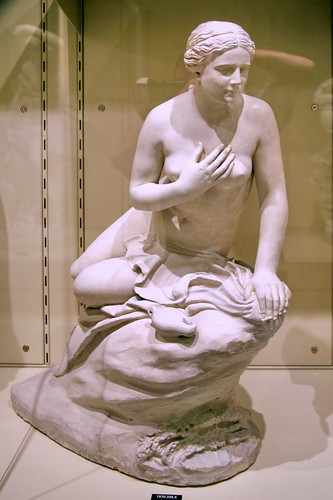
He clapped his plump cheeks, with his tresses played And, smiling wantonly, his love bewrayed. He watched his arms and, as they opened wide At every stroke, betwixt them would he slide And steal a kiss, and then run out and dance, And, as he turned, cast many a lustful glance, And threw him gaudy toys to please his eye, And dive into the water, and there pry Upon his breast, his thighs, and every limb, And up again, and close beside him swim, And talk of love.Or this, between Leander and Hero, his beloved, as she loses her virginity:
For though the rising ivory mount he scaled, Which is with azure circling lines empaled, Much like a globe (a globe may I term this, By which love sails to regions full of bliss) Yet there with Sisyphus he toiled in vain, Till gentle parley did the truce obtain. Wherein Leander on her quivering breast Breathless spoke something, and sighed out the rest;The poem tells the story of two classically star-crossed lovers: the (ironically) virginal priestess of Aphrodite and Leander a man whose beauty Marlowe describes with a wanton luxury of words:
I could tell ye How smooth his breast was and how white his belly; And whose immortal fingers did imprint That heavenly path with many a curious dint That runs along his back, but my rude pen Can hardly blazon forth the loves of men, Much less of powerful gods.They fall in love, she tells him to come to her in her tower, and they... fool around, but don't fully consummate their love. She tells him to come back the next day, but his father finds out and forbids it. Unwilling to give up his love, Leander leaps into the waters of the Hellespont that separate the two, where Neptune, mistaking him for Ganymede, the beautiful cupbearer of Zeus attempts to seduce him. Realizing that the boy is drowning, Neptune figures out it ISN'T an immortal (always a good sign of that, drowning), and after talking to him about how lovely sex between men can be, finally gives up on the boy, and Leander arrives at Hero's tower - naked. Leander flees, to the shadows. Then to her stairs. Then to her room. Then to her bed. Yes, the implication is that she's not REALLY fleeing. The two of them consummate their amours, and the poem draws to a close as the sun rises (it was probably unfinished). I could talk about the beauty of Marlowe's language, I could tell you about the imagery he used, or the symbolic nature of the poem, I could dance endlessly around the central issue, but the central issue is this: this poem is about sex, and about how wonderful and exciting it is, hands down, no question. It's supposed to be a bit of a romp, yes, and admittedly, there is supposed to a bit of humor to Neptune trying to seduce the boy, but really, throughout the work, the poem is intense, erotic, and beautiful. And this is where I find myself stymied. Ironically, while our modern day talks incessantly about sex, there is a sort of code, that we can talk about it only in one of three ways: very clinically (like it's discussed on the news), very humorously (or at least with the attempt to be so), and talking 'dirty'. Our lexicon of sex tends towards the degrading, the angry. It's no coincidence that our words for the sexual act, or for the organs involved are either meant for textbooks, or used dually as descriptors and curse words. This is how sex is in our culture - it is either something we acknowledge logically, or something we're supposed to wallow in. Sex as beautiful gets paid lipservice, and some people really honestly fight for the beauty to come back to sex. But more or less? Sex is something we snigger about. More than anything else, listening to this, I was struck by sadness of that. Sex lives in the shadows of our lives - even of our private lives. Sex is associated with words like 'naughty' and 'dirty', if it's vocalized, often even within couples who have been having sex for ages. It brings up an interesting set of questions, really. For example, why is it hard for a person to tell their lover how great their sex was without either discussing tactics (clinical) or 'talking dirty'? Why is, say, a wife making a video of herself undressing or masturbating for her husband something 'naughty'? Maybe these things should be, I don't know. I certainly am not arguing that people should talk about their sex in the middle of a crowded restaurant the way they talk about the football game, or anything. But, when did 'private' begin to equal 'dirty'? When did 'honest' begin to equal 'clinical'? I don't know the answers, I'm just chewing on the questions Read More......

the monotonous fall of the waves on the beach, which for the most part beat a measured and soothing tattoo to her thoughts seemed consolingly to repeat over and over again as she sat with the children the words of some old cradle song, murmured by nature, ‘I am guarding you—I am your support," but at other times suddenly and unexpectedly, especially when her mind raised itself slightly from the task actually in hand, had no such kindly meaning, but like a ghostly roll of drums remorselessly beat the measure of life, made one think of the destruction of the island and its engulfment in the sea, and warned her whose day had slipped past in one quick doing after another that it was all ephemeral as a rainbow—this sound which had been obscured and concealed under the other sounds suddenly thundered hollow in her ears and made her look up with an impulse of terror.
To the Lighthouse and Mrs Dalloway were the first books of Woolf's I ever read. I don't remember which came first (I believe it was To the Lighthouse), but I remember the contrast in my experience of them. Mrs Dalloway was dark, far away, it did no seem to wish me to come in. As a book, it was forbidding and self-contained, a fortress of a book, filled I was sure with something beautiful, something which I could smell and hear at times, but which I was forbidden to see, simply because I was not worthy of the experience. (I've since peeked my eyes just over the fortress wall, mind you, but nonetheless...).
To the Lighthouse was none of these things. It was inscrutable perhaps, yes, but not inscrutable in the way that the interior of a fortress is, none of the feeling of being kept out of a thing. To the Lighthouse had the inscrutability of the sea - vast, eminently available, explorable, considerable, but nonetheless, unknowable - even as we know it. I feel about To the Lighthouse the way boys in old books felt about the sea: that it is a place where souls are forged, where experiences are had, a place with a certain home-ness to it. To the Lighthouse, like the sea, was a lover, or a harsh mistress. Mrs. Dalloway was a cloud, eminently arrayed but ever out of reach.
Over the past month, it's come to my attention from different people that this is not the normal way of things - that most people feel the opposite way, in fact. I want to tell you what I see in To the Lighthouse, that makes me feel at home - unavoidably my little essay will fail, because the very reason that the book is inscrutable is because the experience of immensity is supposed to be indescribable. That is, I guess, what makes it immense. But, I will have, at least, made the attempt.
For me, To the Lighthouse is a book about inbetween places and people. The lighthouse itself is a perfect example of this - it is a building that is at once of the sea and the sky, built on land that barely exists. It clings to earth - it is immersed in sea and sky. The house has a similar story, particularly in the second part, when it is invaded by the sand and the wind, and starts to decay - before being put aright again by the servants. Mrs Ramsay herself is, in many ways, the same sort of symbol - at once her hands are in the practical world, of raising children and worrying over molehills, of setting up love matches and entertaining guests, while her mind, at a moments notice, is lost in the immensities of thought, ranging over the great questions of philosophy with an easy authenticity that paints the efforts of her husband, or Charles Tannsley as what they are - gropings, accidental spelunkings obtained in pursuit of other ends. The towers of this novel are immensely tied into this to me, into this balance between the great and sensual sea, and the immensity of the sky.
Of course, I know that sounds like a kind of paragraph of nonsense, but there is a reason, for me, that it isn't. The lighthouse, the house, Mrs Ramsay (for everyone but herself), the sea, the sky, the tidal regions of the beach, all these twilit places would seem to tease an obvious question - what do they mean? OR to solidify the question more - these things are like life, halfway between the heavens and the grave, and inevitably bound for one or the other (or both, depending on your philosophy). Humans are, after all, this strange mixture of the sensual and the spiritual, and for eons, man has over and over asked the question - why? Why are we here? Why are we what we are? What are we, eminent strugglers, supposed to struggle against?
I think, though, in To the Lighthouse, this is a deceptive question: the very central point of the book, for me, is that the answer doesn't really matter. Asking the purpose of life is like asking the purpose of the sea, or the purpose of a painting, or the purpose of a child. They are things that simply are.
This may sound like simple old-fashioned Atheism - in a sense it is. It is and it isn't. The character of Charles Tansley shows this - he is the 'quintessential atheist' of the book (I put this in quotes because I don't mean to imply that atheists are like this, or like that, simply that the literary IDEA of an atheist is like Charles Tansley). Charles doesn't believe in nothing, rather he believes in believing in nothing. He believes there is no God, whereas the novel simply doesn't bother believing there is a God - or that there isn't. It accepts that there is a world, that is is here, that we are here, that we will die, and other people will live, that none of will accomplish immortality, and then gently, gently, ever so gently, whispers to us that we will live in it anyway. Like Mrs Ramsey, sometimes that will terrify us, sometimes it will comfort us. And that's okay, and there is no answer that will resolve it for us. In a world with no particular purpose, we must define our own, and we can never be wrong - and we can never be right. We simply will all live, try to do things we think are good, try not to do what we think is bad, and then, one day, we will die. We will paint, or write, or fix computers, and perhaps we'll be remembered for a very long time, or perhaps barely a moment, but eventually, we'll be forgotten. Our happiness will not last, but we will, in spite of that - or maybe because of that - be happy for our moment.
From her hand, ice cold, held deep in the sea, there spurted up a fountain of joy at the change, at the escape, at the adventure (that she should be alive, that she should be there). And the drops falling from this sudden and unthinking fountain of joy fell here and there on the dark, the slumbrous shapes in her mind; shapes of a world not realised but turning in their darkness, catching here and there, a spark of light; Greece, Rome, Constantinople."Read More......
"Yes, she thought, laying down her brush in extreme fatigue, I have had my vision."

